Listen to ArticlePress play to hear this storyListen to ArticleDownload audio
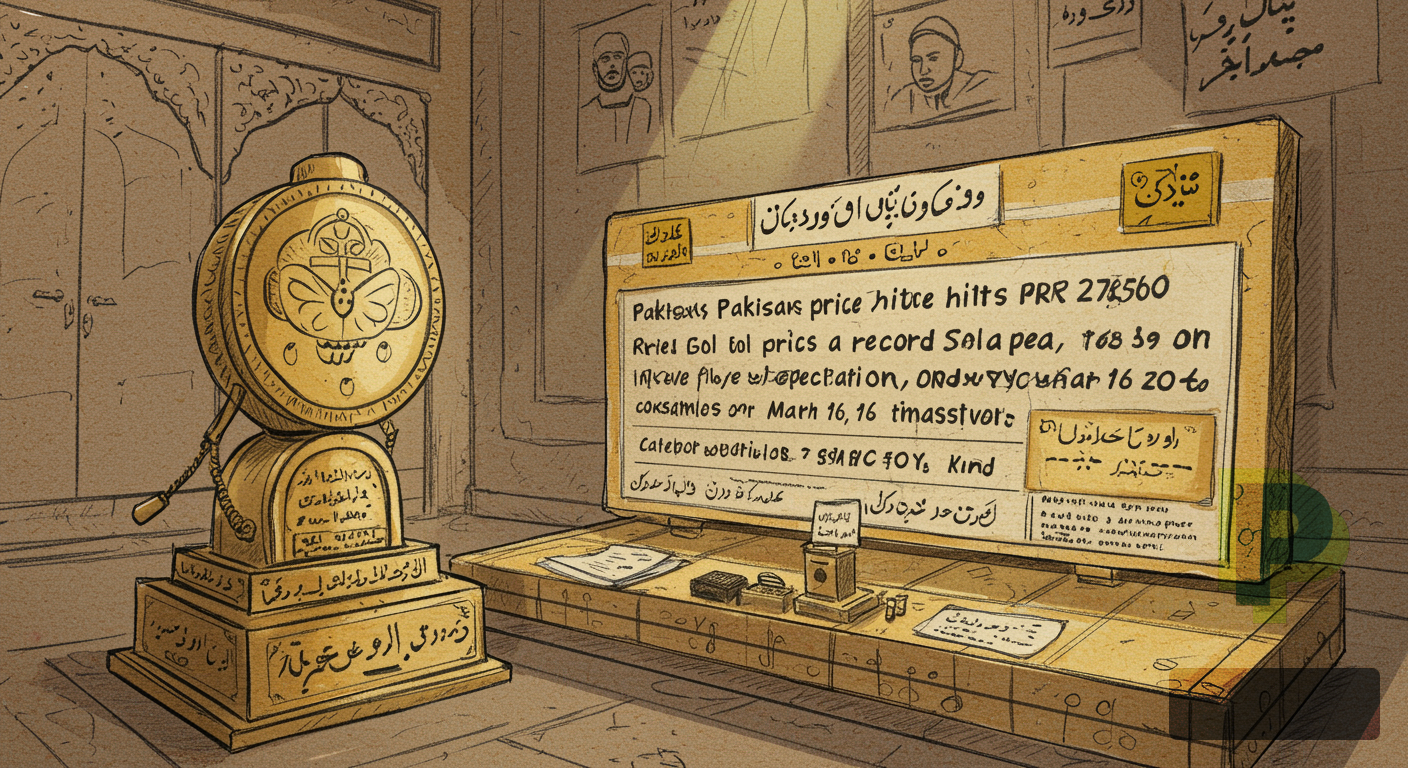
Pakistan's gold price has once again scaled new heights, with 24-karat gold reaching an unprecedented PKR 278,500 per tola on March 16, 2026. This significant surge underscores the persistent economic volatility, including a depreciating Pakistani Rupee and elevated inflation, continuing to drive local demand for the safe-haven asset. The price for 10 grams of 24K gold stood at PKR 238,760, while 22-karat gold was traded at PKR 255,300 per tola, according to data from the Sarafa Bazaar Association, marking a substantial increase from just a year prior.
- Record High: 24-karat gold surged to PKR 278,500 per tola on March 16, 2026.
- Key Drivers: Persistent Pakistani Rupee depreciation, high domestic inflation, and robust international gold prices.
- Economic Impact: Increased financial burden on consumers, particularly for weddings, and challenges for the jewellery industry.
- Investment Shift: Gold remains a primary hedge against economic uncertainty for many Pakistani households.
- Government Response: Continued efforts to curb smuggling and stabilise the national currency.
Key Takeaway: The surge in gold prices on March 16, 2026, highlights Pakistan's ongoing struggle with currency devaluation and inflation, cementing gold's role as a crucial hedge for citizens amidst economic uncertainty.
What Factors Are Driving Pakistan's Gold Price Surge in 2026?
Background and Context: Gold's Enduring Role in Pakistan's Economy
Gold has historically held immense cultural and economic significance in Pakistan, serving as a traditional store of value, a primary component of bridal trousseaus, and a crucial hedge against economic instability. Over the past few years, particularly between 2022 and 2025, Pakistan's economy has been characterised by a series of challenges, including record-high inflation, significant currency depreciation, and a persistent current account deficit. This environment has consistently pushed domestic gold prices upwards, as citizens seek to preserve their wealth against the erosion of the Pakistani Rupee's purchasing power. For instance, in March 2025, the price of 24K gold per tola hovered around PKR 225,000, indicating a 23.7% increase year-on-year to the current PKR 278,500, a trend directly correlated with the country’s macroeconomic indicators.
As PakishNews previously reported, Minal Khan Named Mothercare Pakistan Ambassador, Signalling Evolving Parenting….
The State Bank of Pakistan (SBP) has consistently battled external sector pressures, with foreign exchange reserves often remaining at precarious levels, impacting the country's ability to finance essential imports. As PakishNews previously reported, Pakistan's Economic Outlook continues to be shaped by its commitment to International Monetary Fund (IMF) programmes, which often entail strict fiscal discipline and structural reforms. These reforms, while necessary for long-term stability, can sometimes contribute to short-term inflationary pressures and currency volatility, further bolstering gold's appeal.
Global and Domestic Economic Pressures
The current rise in gold prices is multifaceted, influenced by both international market dynamics and Pakistan's unique domestic economic landscape. Globally, gold's appeal as a safe-haven asset has been strengthened by ongoing geopolitical tensions in Eastern Europe and the Middle East, coupled with uncertainties surrounding global economic growth and central bank monetary policies. As of March 2026, the international spot price for gold on COMEX is trading around $2,280 per ounce, a significant increase from an average of $2,050 per ounce in March 2025, according to Bloomberg data. This robust international performance directly translates into higher local prices, adjusted for the exchange rate.
Domestically, the relentless depreciation of the Pakistani Rupee against the US Dollar remains the most significant driver. As of March 16, 2026, the interbank exchange rate stands at approximately PKR 315 to 1 US Dollar, a notable weakening from PKR 280 in March 2025, as per State Bank of Pakistan data. This 12.5% depreciation means that more rupees are required to purchase the same amount of internationally priced gold. Furthermore, inflation, though showing signs of moderation from its peaks, remains high. The Pakistan Bureau of Statistics reported a Consumer Price Index (CPI) of 18.2% year-on-year for February 2026, significantly above the SBP's target range, compelling individuals to invest in tangible assets like gold to protect their savings.
How Are Gold Price Fluctuations Impacting Pakistani Citizens and the Economy?
Expert Analysis
The soaring gold prices have wide-ranging implications across various segments of Pakistani society and the broader economy. Dr. Aisha Khan, a senior economic analyst at the Institute of Economic Policy, remarked, "Gold's current trajectory in Pakistan is a clear indicator of market mistrust in traditional financial instruments and the persistent inflationary environment. For many, especially those in the informal sector, gold remains the most accessible and trusted hedge against the rupee's instability. However, this also prices out lower and middle-income families from a traditional part of their cultural heritage, particularly for weddings, leading to a shift towards lighter jewellery or even artificial alternatives."
Mr. Muhammad Arshad, President of the Pakistan Gold & Jewellers Association (PGJAP), expressed concerns about the industry's health. "The continuous price hikes have severely impacted demand. Our sales volumes have dropped by an estimated 30-35% in the last year alone, as reported by our members across major cities like Karachi, Lahore, and Islamabad. This not only threatens the livelihoods of thousands of artisans and jewellers but also fuels the informal market, leading to increased smuggling of gold, which deprives the government of legitimate tax revenue." He added that the government's efforts to curb smuggling, while commendable, need to be more comprehensive, involving border management and robust enforcement mechanisms.
A senior official from the Ministry of Finance, speaking on condition of anonymity, acknowledged the challenges: "The government is acutely aware of the economic pressures driving gold prices. Our primary focus remains on macroeconomic stabilisation through fiscal prudence and monetary tightening by the SBP. Efforts are underway to strengthen the rupee through increased foreign direct investment and export promotion, which we believe will eventually ease the pressure on gold prices and reduce its appeal purely as an inflation hedge."
Impact Assessment
The primary impact of high gold prices is felt by ordinary citizens. For families planning weddings, a significant cultural event in Pakistan, the cost of gold jewellery has become prohibitive. Many are opting for smaller quantities, lower caratage, or even renting jewellery, fundamentally altering long-standing traditions. For investors, those who purchased gold earlier have seen substantial gains, but new entrants face a much higher entry barrier, potentially redirecting investment into other assets like real estate or equity, though these also carry their own risks in a volatile market.
The jewellery industry, a significant employer, is grappling with reduced sales, leading to potential job losses and a slowdown in manufacturing. The informal market, including smuggling, thrives on these price disparities and import restrictions, posing a significant challenge to formal businesses and the government's revenue collection efforts. According to Customs Department reports for Q4 2025, gold seizures increased by 18% compared to the previous year, highlighting the scale of the illicit trade. In a related development covered by PakishNews, Anti-Smuggling Operations Intensify Across Pakistan, targeting various commodities including gold.
What Measures is the Government Taking to Stabilise the Gold Market?
The government, in coordination with the State Bank of Pakistan and law enforcement agencies, has been implementing various measures to address the underlying causes of gold price volatility and curb illicit trade. The SBP continues to use monetary policy tools, including maintaining a high policy rate (currently 20.5% as of March 2026), to combat inflation and stabilise the rupee. While these measures have had some effect on overall inflation, their impact on the gold market is often indirect and slower to materialise.
On the regulatory front, the Federal Investigation Agency (FIA) and Customs authorities have intensified their crackdown on gold smuggling. Recent operations along the western borders and at major airports have resulted in significant seizures and arrests. These efforts aim to reduce the supply of undocumented gold in the market, thereby reducing price distortions and increasing legitimate trade. Additionally, the government has explored adjustments to gold import duties and regulations, though frequent changes can sometimes create uncertainty for legitimate importers and jewellers.
Why does gold smuggling remain a persistent challenge for Pakistan?
Gold smuggling remains a persistent challenge for Pakistan due to a confluence of factors, including its long and porous borders with neighbouring countries like Afghanistan and Iran, significant profit margins driven by local price disparities and currency depreciation, and the presence of an entrenched informal economy. The high demand for gold within Pakistan, coupled with import restrictions and duties, creates a lucrative incentive for illicit trade, making it difficult for enforcement agencies to completely stem the flow despite intensified efforts. This phenomenon not only impacts domestic gold prices but also contributes to capital flight and hinders formal economic growth.
What Happens Next: Outlook for Gold Prices and Economic Stability
The trajectory of gold prices in Pakistan for the remainder of 2026 will largely depend on a combination of global and domestic economic factors. Internationally, any significant shifts in global interest rates, particularly by the US Federal Reserve, or de-escalation of geopolitical tensions could temper international gold prices. Domestically, the government's ability to maintain fiscal discipline, attract foreign investment, and control inflation will be paramount in stabilising the Pakistani Rupee. Should the rupee show sustained appreciation and inflation ease significantly, the incentive to hold gold as a hedge might diminish, leading to a potential stabilisation or even a slight correction in local prices.
Conversely, continued economic pressures, a further weakening of the rupee, or an uptick in global gold demand could push prices even higher, exacerbating the challenges for consumers and legitimate businesses. Stakeholders, including policymakers, the State Bank of Pakistan, and the business community, will be closely watching the upcoming budget announcements, the performance of the external sector, and global commodity markets for any indicators of future trends. The government's success in implementing structural reforms and curtailing illicit trade will be crucial in restoring confidence and ensuring a more stable economic environment for all.
Related: More Pakistan Economy News | Currency Exchange Trends
Related Coverage
- Minal Khan Named Mothercare Pakistan Ambassador, Signalling Evolving Parenting Campaigns
- Pakistan Alleges Afghan Taliban Bajaur Attack Killed Four Civilians
- Pakistan: Navigating the Crossroads of Trade and Security Corridors
Quick Answers (AI Overview)
- What happened in this story?
Pakistan's gold price has once again scaled new heights, with 24-karat gold reaching an unprecedented PKR 278,500 per tola on March 16, 2026. This significant surge underscores the persistent economic volatility, includi - Why does this matter right now?
It matters because gold price in pakistan soars to record highs amid persistent economic volatility (march 16, 2026) can impact public discussion, policy, or regional stability depending on follow-up events. - What should readers watch next?
Watch for official statements, verified facts, and timeline updates from credible sources including samaa tv.
Frequently Asked Questions
❓ What was the gold price in Pakistan on March 16, 2026?
On March 16, 2026, the price of 24-karat gold in Pakistan reached PKR 278,500 per tola, while 10 grams of 24K gold were priced at PKR 238,760. This represents a significant increase of approximately 23.7% compared to March 2025 prices, reflecting ongoing economic pressures and global market trends.
❓ How does the Pakistani Rupee's value affect local gold prices?
The value of the Pakistani Rupee has a direct and substantial impact on local gold prices because gold is an internationally traded commodity priced in US Dollars. As of March 2026, with the interbank exchange rate at roughly PKR 315 to $1, a weaker rupee translates into a higher rupee price for the same amount of gold, effectively making it more expensive for local buyers.
❓ What is the government doing to address rising gold prices and related issues?
The government is primarily focused on macroeconomic stabilisation through fiscal prudence and monetary tightening by the State Bank of Pakistan, which includes maintaining a high policy rate of 20.5% as of March 2026. Additionally, law enforcement agencies like the FIA and Customs are intensifying efforts against gold smuggling to curb illicit trade and reduce price distortions in the formal market.