
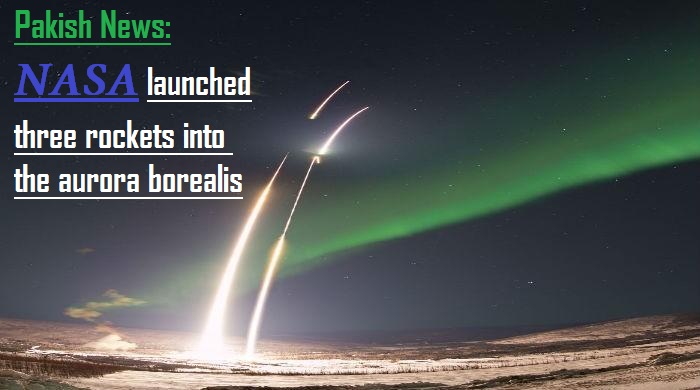

The Northern Lights, or aurora borealis, have long captivated imaginations with their dazzling displays of green and pink hues. These colors are produced when electrically charged particles from space collide with gases in the Earth's atmosphere, creating a breathtaking natural spectacle. To further unravel the secrets behind this phenomenon, the National Aeronautics and Space Administration (NASA) recently launched three rockets into the aurora from Alaska’s Poker Flat Research Range. According to Space.com, all three Black Brant IX sounding rockets were launched within a two-hour window on March 2. Since January, NASA has sent a total of five such rockets into the Northern Lights as part of an ambitious research campaign. The mission aims to study various aspects of the aurora, including the ionosphere and Earth’s magnetic field. The campaign began on January 19, with another rocket launched on February 22. Scientists hope to better understand how the aurora connects solar wind activity to atmospheric processes. Kristina Lynch, principal investigator for the ISINGLASS project, explained, “The visible light produced in the atmosphere as aurora is the last step of a chain of processes connecting the solar wind to the atmosphere. We are seeking to understand what structure in these visible signatures can tell us about the electrodynamics of processes higher up.” The mission teams have successfully collected and transmitted data, which is now under review. In addition to these scientific missions, NASA’s leadership is considering the possibility of sending astronauts on future flights aboard the Orion spacecraft and the Space Launch System (SLS)—the agency’s most powerful rocket under development. Bill Gerstenmaier, NASA’s associate administrator for human exploration, emphasized, “Our priority is to ensure the safe and effective execution of all our planned exploration missions with the Orion spacecraft and Space Launch System rocket.” As NASA continues to push the boundaries of space science, these missions promise to shed new light on the aurora and deepen our understanding of the dynamic relationship between the sun and Earth.

