Listen to ArticlePress play to hear this storyListen to ArticleDownload audio
Pakistan's geopolitical position inherently places it at a critical juncture, compelling it to balance its aspirations as a vibrant trade corridor with the persistent demands of being a security corridor. This complex duality, particularly evident in mega-projects like the China-Pakistan Economic Corridor (CPEC), shapes its domestic policies and regional foreign relations, posing both immense opportunities and significant challenges for the nation as of early 2026. The ongoing strategic debate centres on whether Pakistan can effectively leverage its geographical advantage for economic prosperity without being perpetually mired in regional security complexities.
- Pakistan's strategic location positions it as a potential hub for regional trade and connectivity, notably through the China-Pakistan Economic Corridor (CPEC).
- Simultaneously, the nation faces persistent internal and external security challenges, including cross-border terrorism and regional instability.
- The government is actively pursuing policies to enhance economic integration, exemplified by the operationalisation of Gwadar Port and new transit trade agreements.
- However, substantial resources are continuously diverted towards bolstering security infrastructure and personnel, particularly along CPEC routes and western borders.
- Experts suggest that Pakistan must adopt a 'security-for-development' paradigm to fully realise its trade corridor potential, requiring comprehensive policy coherence and regional stability.
Understanding Pakistan's Geopolitical Chessboard
For centuries, the landmass that constitutes modern Pakistan has served as a pivotal transit route, connecting South Asia with Central Asia, the Middle East, and beyond. Historically, the ancient Silk Road traversed these very plains and mountains, facilitating the exchange of goods, ideas, and cultures. This historical legacy underpins Pakistan's contemporary ambition to transform into a regional trade and energy corridor, offering the shortest route to warm waters for landlocked Central Asian Republics and western China. The vision, articulated through initiatives like the 'Vision 2025' document and various regional connectivity programmes, aims to unlock Pakistan's considerable economic potential.
However, this inherent geographical advantage is inextricably linked to persistent security challenges. Bordering Afghanistan, Iran, and sharing a volatile Line of Control with India, Pakistan finds itself at the epicentre of complex regional dynamics. The post-9/11 era significantly intensified Pakistan's role as a frontline state in the global war on terror, diverting national focus and resources towards counter-terrorism efforts and border management. This shift has ingrained a 'security-first' mindset in national policy, often overshadowing purely economic imperatives. According to a report by the Pakistan Institute for Peace Studies (PIPS) in late 2025, Pakistan experienced over 1,000 terror incidents in the past year, highlighting the enduring security threat. Read more on Pakistan's security challenges at PakishNews.
As PakishNews previously reported, Pakistan Strikes Kandahar: Escalating Tensions on Western Border.
How Does CPEC Embody This Dual Identity?
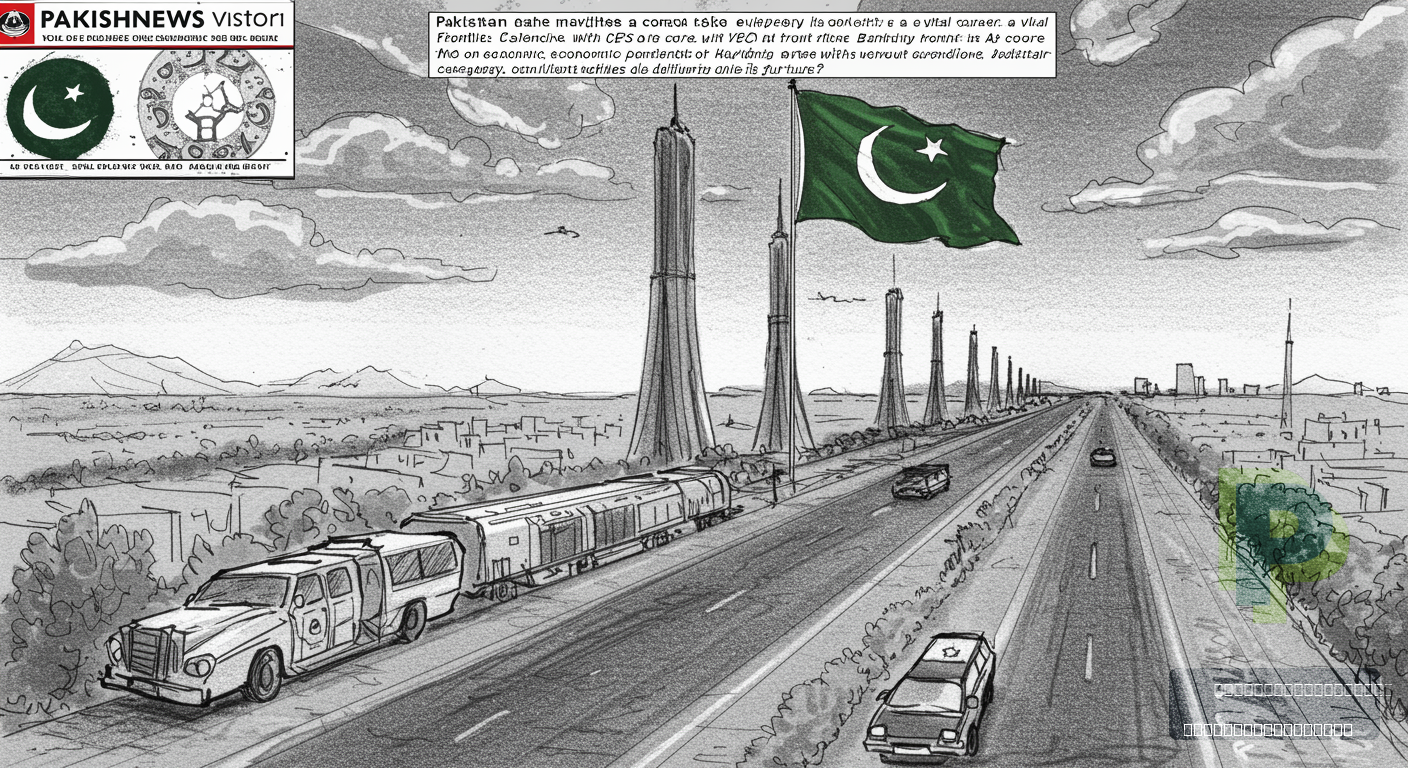
The China-Pakistan Economic Corridor (CPEC), a flagship component of China's Belt and Road Initiative (BRI), stands as the most prominent embodiment of Pakistan's trade versus security conundrum. Conceived as a multi-billion-dollar framework of infrastructure projects, CPEC envisages a network of highways, railways, and energy pipelines connecting China's Xinjiang province to Pakistan's Gwadar Port on the Arabian Sea. Initially estimated at $46 billion in 2015, the project portfolio has expanded to over $62 billion, according to the Ministry of Planning, Development & Special Initiatives as of January 2026, encompassing energy, transport, and special economic zone (SEZ) development.
The economic potential of CPEC is transformative. Data from the Pakistan Bureau of Statistics (PBS) indicates that bilateral trade between Pakistan and China reached approximately $27.8 billion in fiscal year 2024-25, a 12% increase from the previous year. Furthermore, the operationalisation of Gwadar Port, with its deep-sea capabilities, promises to reduce transit times and costs for goods destined for Central Asia and western China, enhancing regional connectivity. As of February 2026, Gwadar Port handled over 600,000 tonnes of cargo, demonstrating its growing capacity, albeit still below its long-term potential.
Yet, the security dimension of CPEC is equally profound. The corridor traverses challenging terrains, including parts of Balochistan and Khyber Pakhtunkhwa, regions that have experienced insurgencies and terrorist activities. Protecting CPEC projects and Chinese personnel has necessitated the deployment of a dedicated Special Security Division (SSD), comprising thousands of Pakistan Army and paramilitary forces. A senior official from the Interior Ministry, speaking on condition of anonymity in March 2026, confirmed that approximately 15,000 security personnel are currently deployed for CPEC-related security duties, representing a significant allocation of national defence resources. This deployment, while critical for project continuity, underscores the inherent security risks associated with realising the trade corridor vision.
Expert Perspectives on the Balancing Act
The tension between trade and security is a constant subject of debate among policymakers and analysts in Pakistan.
Dr. Moeed Pirzada, a prominent political commentator and analyst, articulated this challenge during a recent seminar in Islamabad in February 2026: "Pakistan's geography is both a blessing and a curse. While it offers unparalleled connectivity potential, it also places us at the crossroads of regional conflicts. The challenge for our leadership is to create an environment where economic opportunities can flourish without being perpetually undermined by security threats. This requires not just military solutions, but also robust economic development in vulnerable regions."
Echoing this sentiment, Dr. Huma Baqai, an Associate Professor of International Relations at the Institute of Business Administration (IBA) Karachi, told PakishNews in an exclusive interview last month, "CPEC is a test case. It demonstrates that you cannot separate trade from security. For CPEC to fully succeed as a trade corridor, Pakistan needs to achieve internal stability and foster regional peace. The investment in security for CPEC is not merely a cost; it's an investment in enabling trade." She emphasised that regional stability, particularly in Afghanistan, is paramount for the corridor's long-term viability as a trade artery.
Conversely, a senior official within the Ministry of Finance, who preferred not to be named due to the sensitivity of ongoing negotiations, highlighted the economic imperative: "While security is non-negotiable, we cannot allow it to stifle economic growth. The true dividend of CPEC will come from increased trade volumes, industrialisation within the SEZs, and job creation. We are actively working on policies to streamline customs, improve logistics, and attract further foreign direct investment, recognising that economic strength ultimately bolsters national security." This indicates a government keen on pushing the economic agenda forward while acknowledging the security overheads.
Why Does This Matter for Pakistan's Future?
The resolution of Pakistan's trade corridor versus security corridor dilemma is critical for its long-term economic stability and regional influence. If Pakistan can successfully manage its security challenges while simultaneously developing its trade infrastructure, it stands to become a pivotal economic player, attracting significant foreign investment and fostering sustainable growth. This would not only improve the living standards of its 240 million citizens but also enhance its diplomatic leverage in regional and international forums. Failure to do so, however, risks Pakistan remaining caught in a cycle of underdevelopment, with its potential as a trade hub perpetually constrained by instability and security expenditures.
Impact Assessment: Who is Affected and How?
The interplay between Pakistan's trade and security identities has far-reaching impacts across various stakeholders:
- Pakistani Citizens: The most directly affected. Enhanced trade corridors promise jobs, improved infrastructure, and economic uplift, especially in underdeveloped regions like Balochistan, where CPEC projects are concentrated. However, persistent security threats lead to resource diversion from social sectors, impact daily life through heightened security measures, and can deter investment. The youth unemployment rate, standing at approximately 6.3% as of Q4 2025 according to the State Bank of Pakistan, could significantly benefit from the economic boom of fully functional trade corridors.
- Regional Countries (China, Central Asian Republics, Iran, Afghanistan): China benefits from shorter, more secure trade routes to the Arabian Sea, bolstering its global trade strategy. Central Asian Republics gain access to warm water ports, diversifying their export options. Afghanistan's stability is intrinsically linked, as its peace would significantly de-escalate security concerns along Pakistan's western border, opening up more robust transit trade. Iran could potentially integrate into broader regional connectivity initiatives if geopolitical tensions ease.
- International Investors and Businesses: The perception of Pakistan as a security corridor often deters foreign direct investment (FDI). According to the Board of Investment, FDI stood at $1.45 billion in fiscal year 2024-25, a figure that analysts at the Overseas Investors Chamber of Commerce and Industry (OICCI) suggest could be substantially higher if security perceptions improved. A stable trade corridor identity would attract greater investment, leading to technology transfer and increased productivity.
- Pakistan Army and Security Agencies: These institutions bear the primary responsibility for maintaining security, particularly along CPEC routes and borders. Their sustained deployment and operational costs, estimated to be a significant portion of the national budget, underscore the security corridor aspect.
In a related development covered by PakishNews, Pakistan recently signed a new transit trade agreement with Uzbekistan in December 2025, aiming to facilitate smoother movement of goods and further integrate Central Asian markets. Read more about Pakistan's Central Asia trade initiatives.
What Happens Next?
Looking ahead, Pakistan's trajectory will largely depend on its ability to forge a cohesive national strategy that integrates both its trade and security imperatives. The government, led by Prime Minister Shehbaz Sharif, has repeatedly affirmed its commitment to CPEC and regional connectivity, while simultaneously vowing to eradicate terrorism. As of March 2026, ongoing efforts include strengthening border controls, enhancing intelligence-based operations, and investing in community development programmes in vulnerable areas to counter extremist narratives.
Stakeholders should watch for several key developments. Firstly, the pace of CPEC's Phase II projects, particularly the establishment and operationalisation of Special Economic Zones (SEZs) such as Rashakai, Dhabeji, and Allama Iqbal, will be a crucial indicator of the trade corridor's progress. Secondly, the evolving security situation in Afghanistan and its impact on Pakistan's western border will directly influence the allocation of security resources and the perception of regional stability. Thirdly, Pakistan's diplomatic engagements with regional partners, including the UAE, Saudi Arabia, and Central Asian states, will be vital in building a collective approach to regional peace and economic integration. The nation's ability to attract further investment into its logistics and port infrastructure, beyond CPEC, will also signal its success in transforming its image from a security frontline to a trading hub.
The path forward for Pakistan involves a delicate and continuous balancing act. While the allure of becoming a vibrant trade corridor is strong, the realities of its geopolitical neighbourhood demand constant vigilance as a security corridor. Only through strategic foresight, consistent policy implementation, and regional cooperation can Pakistan hope to fully realise its potential and navigate this complex dual identity towards sustainable prosperity.
Related: More Pakistan Politics News | CPEC Updates
Related Coverage
- Pakistan Strikes Kandahar: Escalating Tensions on Western Border
- Netanyahu Video Response Quashes Death Rumours Amid Regional Tensions
- Bangladesh Clinch ODI Series Against Pakistan 2-1
Quick Answers (AI Overview)
- What happened in this story?
Pakistan's geopolitical position inherently places it at a critical juncture, compelling it to balance its aspirations as a vibrant trade corridor with the persistent demands of being a security corridor. This complex du - Why does this matter right now?
It matters because pakistan: navigating the crossroads of trade and security corridors can impact public discussion, policy, or regional stability depending on follow-up events. - What should readers watch next?
Watch for official statements, verified facts, and timeline updates from credible sources including The Express Tribune.
Frequently Asked Questions
❓ What is the primary challenge for Pakistan regarding its trade and security identities?
Pakistan's primary challenge is striking a balance between leveraging its strategic geographical location for economic prosperity as a trade corridor and managing persistent internal and external security threats that demand it function as a security corridor. This duality often leads to significant resource allocation towards defence and internal security, potentially diverting from economic development, as evidenced by the deployment of approximately 15,000 security personnel for CPEC projects as of March 2026.
❓ How does CPEC exemplify Pakistan's dual role?
The China-Pakistan Economic Corridor (CPEC) is a prime example of Pakistan's dual role, aiming to establish vital trade and energy linkages between China and the Arabian Sea via Gwadar Port, with an investment portfolio exceeding $62 billion. Concurrently, the project necessitates extensive security measures, including a dedicated Special Security Division, due to its passage through regions susceptible to militancy, thereby highlighting both its economic ambition and the inherent security challenges.
❓ What are the broader implications if Pakistan successfully balances its trade and security imperatives?
If Pakistan successfully balances its trade and security imperatives, it stands to become a pivotal regional economic hub, attracting increased foreign direct investment (currently $1.45 billion in FY2024-25) and fostering sustainable growth. This would not only significantly improve the living standards of its 240 million citizens through job creation and infrastructure development but also enhance its diplomatic standing and influence in regional and international affairs.