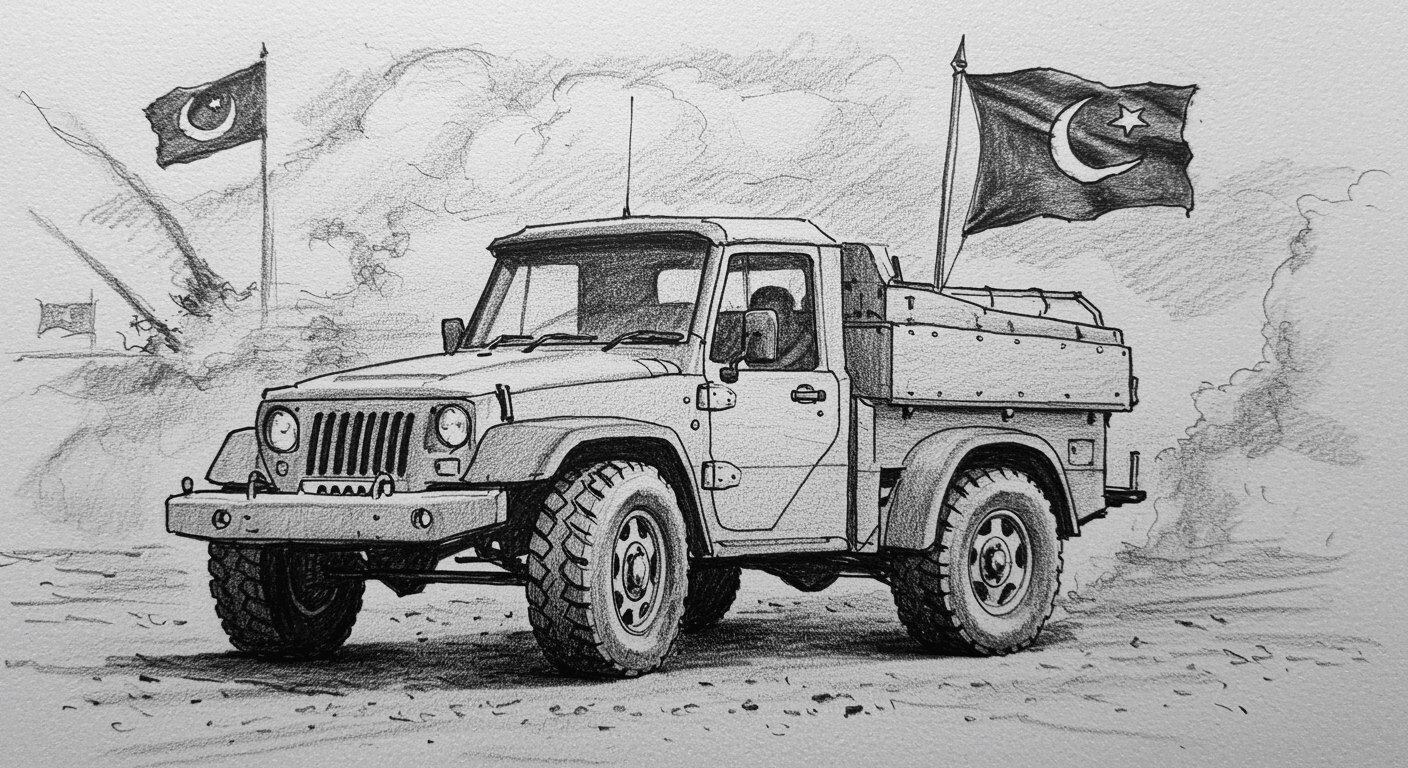
Image generated by PakishNews AI (Vertex Imagen)
PakishNews ListenPress play to hear this articleDownload audio
Islamabad, Pakistan – Pakistan’s military conducted targeted strikes on an Afghan base on March 18, 2024, in a significant escalation of tensions, hours after President Arif Alvi warned that Pakistan's patience had reached a 'red line' regarding persistent cross-border militant activities. This retaliatory action underscores Pakistan's resolve to address the persistent threat posed by Tehrik-i-Taliban Pakistan (TTP) operating from Afghan soil, marking a critical juncture in the increasingly fraught relationship between the two neighbouring nations. The strikes, confirmed by Pakistan's Inter-Services Public Relations (ISPR), were reportedly aimed at militant hideouts within Afghanistan, specifically targeting elements involved in recent terror attacks on Pakistani soil.
- **Date of Strike:** Pakistan's military conducted targeted strikes on March 18, 2024, in Afghanistan.
- **Preceding Warning:** The action followed a stern warning from President Arif Alvi regarding Pakistan's 'red line' on cross-border terrorism.
- **Target:** Reports indicate the strikes targeted militant hideouts, primarily those associated with the Tehrik-i-Taliban Pakistan (TTP).
- **Context:** The strikes are a direct response to a significant increase in terror attacks within Pakistan, which Islamabad attributes to groups operating from Afghanistan.
- **Implications:** This event marks a severe escalation in Pakistan-Afghanistan relations and raises concerns about regional stability.
**Why Has Pakistan Struck an Afghan Base Now?**
As PakishNews previously reported, 4.0 Magnitude Earthquake Strikes Southern Pakistan, Renews Seismic Focus.
The recent military action by Pakistan against an Afghan base on March 18, 2024, stems from a culmination of escalating cross-border attacks and what Islamabad perceives as a lack of concrete action by the interim Afghan government to curb militant groups, particularly the Tehrik-i-Taliban Pakistan (TTP). For months, Pakistani officials have voiced growing frustration over the TTP's resurgence and its use of Afghan territory as a launching pad for attacks within Pakistan. According to data released by the Pakistan Institute for Peace Studies (PIPS), Pakistan witnessed a 50% increase in terror attacks in 2023 compared to the previous year, with a significant proportion claimed by or attributed to the TTP. This surge in violence, which resulted in over 1,000 casualties in 2023, has placed immense pressure on Pakistan's security apparatus and political leadership.
President Arif Alvi's 'red line' warning, delivered just hours before the strikes, encapsulated Pakistan's diminishing patience. A senior official within the Ministry of Foreign Affairs, speaking on condition of anonymity to PakishNews, stated, "We have repeatedly engaged with the Afghan interim authorities at multiple levels, sharing actionable intelligence and urging them to fulfil their commitments under international law to not allow their soil to be used against any other country. The President's statement was a final diplomatic signal that further inaction would necessitate a direct response." This sentiment aligns with Pakistan’s long-standing position that the TTP, despite its ideological links to the Afghan Taliban, remains a distinct and hostile entity threatening Pakistan’s national security. The strikes represent a shift from diplomatic overtures and border fence fortifications to direct kinetic action, signalling a more assertive posture from Islamabad.
**Historical Context: A Troubled Border and Resurgent Threats**
Pakistan and Afghanistan share a porous 2,600-kilometre border, known as the Durand Line, which has historically been a flashpoint for disputes and cross-border movement. The issue of militant sanctuaries on Afghan soil is not new; it has plagued bilateral relations for decades, particularly during periods of instability in Afghanistan. Following the withdrawal of US and NATO forces in August 2021 and the subsequent takeover by the Taliban interim government, Islamabad had initially hoped for improved border security and a crackdown on anti-Pakistan militant groups. However, these hopes have largely been dashed. Instead, the TTP, which had been significantly weakened by Pakistan's military operations like Zarb-e-Azb (2014) and Radd-ul-Fasaad (2017), found renewed space and operational capabilities.
Reports from Pakistan's intelligence agencies, frequently cited by Interior Minister Mohsin Naqvi, indicate that TTP leadership and fighters have found safe haven in various Afghan provinces, from where they plan and execute attacks. The group has claimed responsibility for several high-profile incidents, including the attack on a police compound in Karachi in February 2023 and numerous assaults on security forces in Khyber Pakhtunkhwa and Balochistan. The economic cost of this instability is substantial; the Ministry of Finance estimates that the ongoing security challenges, particularly in border regions, have negatively impacted trade routes and foreign investment, contributing to a projected 0.5% drag on GDP growth for the current fiscal year. This sustained threat, coupled with the perceived intransigence from Kabul, has pushed Pakistan towards a more forceful approach.
**Expert Analysis on Pakistan’s Strategic Shift**
"Pakistan's decision to conduct strikes represents a clear shift in its counter-terrorism strategy towards Afghanistan," stated Dr. Hassan Askari Rizvi, a prominent defence analyst based in Lahore. "For too long, Pakistan has relied on diplomatic channels and border management. This action indicates that Islamabad believes the cost of inaction has become higher than the risk of direct intervention. It's a calculated move to signal to the Afghan interim government that Pakistan will not tolerate the continued use of Afghan territory by TTP, regardless of their internal political dynamics." Dr. Rizvi further elaborated that while such actions carry inherent risks of escalating regional tensions, they also project an image of resolve to domestic audiences and international partners concerned about the spread of militancy.
Echoing this sentiment, Ambassador (Retd.) Tasneem Aslam, a former spokesperson for the Ministry of Foreign Affairs, told PakishNews, "The 'red line' warning from President Alvi was a deliberate articulation of Pakistan's national security imperatives. This isn't merely about individual attacks; it's about the fundamental principle of state sovereignty and the right to self-defence against external threats. The strikes, while regrettable in terms of bilateral relations, are a proportional response to a sustained campaign of terror originating from across the border. They also serve as a message to other regional actors about the seriousness with which Pakistan views its security." These views highlight the long-term strategic calculations behind Pakistan's decision, moving beyond immediate retaliation to a broader policy statement.
**Impact Assessment: Who is Affected and How?**
The immediate impact of Pakistan’s strikes is multifaceted. Firstly, it sends a strong message to the TTP and other militant groups that their sanctuaries are no longer inviolable, potentially disrupting their operational planning and capabilities. However, the precise extent of this disruption remains to be seen. Secondly, it severely strains Pakistan-Afghanistan relations, which were already tenuous. The interim Afghan government, while denying the presence of TTP leaders, has condemned the strikes as a violation of its sovereignty, potentially leading to further diplomatic standoffs or even limited border skirmishes. According to a report by the United Nations Assistance Mission in Afghanistan (UNAMA) on cross-border incidents, the number of such events along the Pakistan-Afghanistan border increased by 25% in the latter half of 2023.
Economically, the heightened tensions could further disrupt cross-border trade, which, according to the Ministry of Commerce, amounted to approximately $1.5 billion in 2023. Any prolonged closure of key border crossings like Torkham and Chaman would disproportionately affect traders and local communities dependent on this commerce. Furthermore, the strikes could impact the estimated 1.3 million registered Afghan refugees and hundreds of thousands of undocumented Afghans residing in Pakistan, potentially leading to renewed calls for their repatriation amidst a deteriorating security environment. The human cost of increased instability in the border regions, particularly for Pashtun communities living on both sides, is also a significant concern, with fears of displacement and disruption of livelihoods.
**What Happens Next: Navigating a Volatile Regional Landscape?**
The path forward for Pakistan and Afghanistan is fraught with challenges. Islamabad will likely maintain pressure on the Afghan interim government to visibly dismantle TTP sanctuaries and hand over key leaders. This could involve continued diplomatic engagement, backed by the implicit threat of further military action. However, the Afghan Taliban faces its own internal pressures and ideological constraints regarding action against groups like TTP, which they view as fellow ideological travellers. This fundamental divergence makes a swift resolution unlikely. As PakishNews previously reported, the complexities of tribal loyalties and the rugged terrain further complicate any counter-terrorism efforts.
Regionally, the strikes could draw attention from international powers, particularly those concerned about stability in South Asia and the potential for a wider conflict. China, a key ally for Pakistan and an investor in Afghanistan's resources, will likely advocate for de-escalation and dialogue, given its significant investment in the China-Pakistan Economic Corridor (CPEC), which requires regional stability. The United States, while no longer directly involved in Afghanistan, has consistently urged the Taliban to prevent the use of Afghan soil for international terrorism. The coming weeks will be crucial in determining whether this latest escalation leads to a sustained period of confrontation or a renewed push for a more effective, albeit difficult, counter-terrorism cooperation framework. Stakeholders, from policymakers to business leaders, will be closely watching for signs of de-escalation or further retaliatory actions from either side, which could have profound implications for the broader security architecture of the region. Read more on regional security challenges at PakishNews.
Related: More Pakistan News | Cross-border Terrorism
Related Coverage
- 4.0 Magnitude Earthquake Strikes Southern Pakistan, Renews Seismic Focus
- Pakistan's President Declares 'Red Line' Crossed Over Afghan Drone Attacks
- Pakistan Rejects Taliban Claim of Border Post Capture, Calls it 'Fabricated'
Quick Answers (AI Overview)
- What happened in this story?
Pakistan's military conducted targeted strikes on an Afghan base on March 18, 2024, in a significant escalation of tensions, hours after President Arif Alvi warned that Pakistan's patience had reached a 'red line' regard - Why does this matter right now?
It matters because pakistan strikes afghan base after 'red line' warning can impact public discussion, policy, or regional stability depending on follow-up events. - What should readers watch next?
Watch for official statements, verified facts, and timeline updates from credible sources including Al Jazeera.
Frequently Asked Questions
❓ What is the Tehrik-i-Taliban Pakistan (TTP)?
The Tehrik-i-Taliban Pakistan (TTP), often referred to as the Pakistani Taliban, is a proscribed militant group formed in 2007, distinct from the Afghan Taliban but sharing a similar ideology. It aims to overthrow the Pakistani government and impose its interpretation of Sharia law. According to the National Counter Terrorism Authority (NACTA), the TTP has been responsible for thousands of deaths in Pakistan since its inception.
❓ How has the Afghan Taliban's return to power impacted cross-border security?
The Afghan Taliban's return to power in August 2021 significantly exacerbated cross-border security concerns for Pakistan. While Islamabad initially hoped for cooperation, the TTP has reportedly found renewed safe haven and operational freedom in Afghanistan, leading to a substantial increase in terror attacks on Pakistani soil. Data from the Ministry of Interior indicates a 50% rise in militant attacks in Pakistan in 2023 compared to the year prior, largely attributed to TTP activities from across the border.
❓ What are the potential international reactions to Pakistan's strikes?
International reactions to Pakistan's strikes are likely to be mixed, with calls for de-escalation and diplomatic resolution. Key allies like China will likely urge restraint due to regional stability concerns, especially concerning CPEC. Western nations, while often condemning terrorism, may express concern over sovereignty violations but also acknowledge Pakistan's legitimate security grievances, as the United States has previously urged the Afghan Taliban to prevent the use of their territory for international terrorism.