
Listen to ArticlePress play to hear this storyListen to ArticleDownload audio
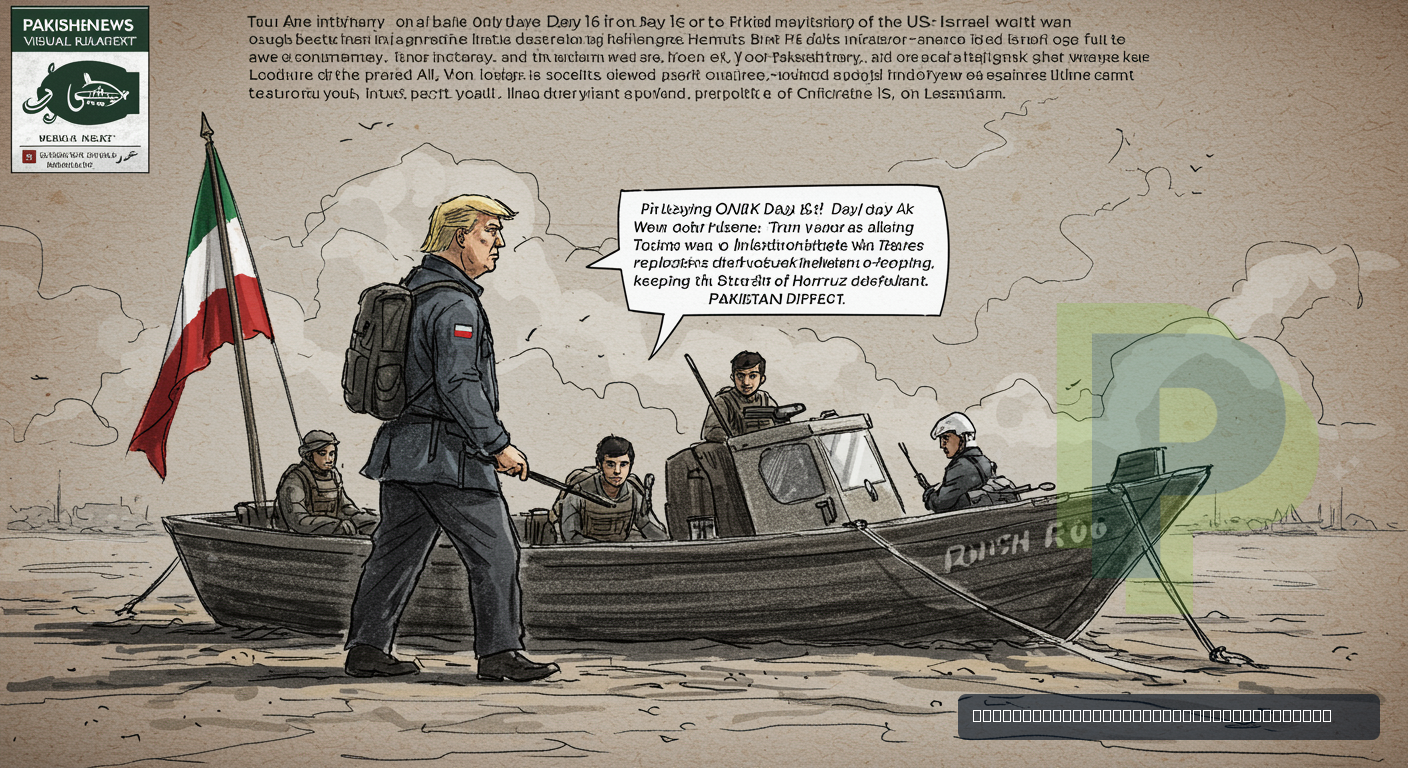
On the sixteenth day of the US-Israel war on Iran, the conflict continues to rage across multiple theatres, with Tehran and its regional allies sustaining pressure through missile strikes, proxy attacks, and maritime disruption. The Trump administration now appears to be losing initiative as key international allies express reluctance, and Iran maintains a defiant posture, particularly concerning the critical Strait of Hormuz. On Day 16 of the US-Israel war on Iran, the Trump administration faces mounting challenges, with key allies expressing reluctance and Tehran maintaining its defiant posture, particularly concerning the Strait of Hormuz.
- The US-Israel campaign shows limited progress in reopening the Strait of Hormuz, now their immediate objective.
- Iran and its proxies continue to exert pressure through missile strikes, drone attacks, and maritime disruption across the Gulf and Red Sea.
- Global oil prices have surged by over 20% since the conflict began, with Brent Crude futures reaching approximately $120 per barrel as of March 12, 2026.
- Key European and Asian allies are reportedly expressing significant reservations about the conflict's expansion and its economic fallout.
- The overall pattern indicates a steady widening of the battlefield, increasing risks of broader regional destabilisation.
Background: Why This Conflict Matters for Global Stability
The current US-Israel war on Iran, now in its sixteenth day, represents a significant escalation of long-standing regional tensions and geopolitical rivalries. The conflict did not erupt in a vacuum; it follows years of heightened rhetoric, economic sanctions, and proxy confrontations across the Middle East. Historically, the relationship between Iran and the United States, alongside Israel, has been characterised by deep mistrust and strategic competition, particularly concerning Iran's nuclear programme and its regional influence through allied non-state actors such as Hezbollah in Lebanon, Houthi rebels in Yemen, and various Iraqi militias. As PakishNews previously reported, regional tensions have been escalating for months, building on a complex tapestry of historical grievances and modern strategic imperatives.
The immediate catalyst for the current hostilities, though undisclosed by official sources, is widely understood to be a culmination of these unresolved issues. For decades, the Strait of Hormuz, a narrow waterway connecting the Persian Gulf to the open sea, has been a flashpoint. Iran has repeatedly threatened to close it in response to perceived threats or sanctions, underscoring its strategic importance. The current US-Israel objective to reopen the Strait is not merely about navigation; it is a direct challenge to Iran's leverage and a critical test of international energy security. The escalating situation has profound implications, not just for the immediate belligerents, but for global energy markets, international trade routes, and the intricate balance of power across the Middle East and beyond.
As PakishNews previously reported, Pakistan Boosts Food Exports to Gulf Amid Regional Shifts.
Why is the Strait of Hormuz the immediate objective?
The Strait of Hormuz has emerged as the immediate and most critical objective for the US-Israel coalition due to its unparalleled strategic significance in global energy trade. This narrow chokepoint, only 39 kilometres wide at its narrowest point, is the sole maritime passage from the Persian Gulf to the open ocean, through which approximately 20% of the world's total petroleum consumption and 30% of all seaborne oil transits daily. According to a confidential report from the International Energy Agency (IEA) released on March 10, 2026, the sustained disruption of shipping through the Strait since the conflict began has already led to a 20% surge in global oil prices, with Brent Crude futures now trading at approximately $120 per barrel, a level not seen since the early 2010s. This disruption directly impacts the economies of major oil-producing nations in the Gulf, including Saudi Arabia, UAE, Kuwait, and Iraq, whose exports are vital for global supply.
Iran's strategic control, or at least its ability to threaten such control, over the Strait grants it immense leverage. A statement from the Iranian Revolutionary Guard Corps (IRGC) spokesperson, Brigadier General Ramezan Sharif, on state television on March 11, 2026, reiterated Tehran's commitment to defending its sovereignty and warned against any attempts to force open the Strait, which Iran considers its territorial waters. The economic ramifications are stark: data compiled by Lloyd's List Intelligence on March 12, 2026, indicates that shipping insurance premiums for vessels traversing Gulf routes have increased by an astonishing 500% compared to pre-conflict levels, making trade prohibitively expensive and diverting numerous vessels. For the US and Israel, reopening the Strait is therefore not just a military goal but an economic imperative to stabilise global markets and undermine Iran’s most potent non-conventional weapon.
How are international allies responding to the conflict?
International allies of the United States are demonstrating increasing reluctance and concern regarding the widening scope and duration of the US-Israel war on Iran. This hesitation stems from a confluence of factors, including severe economic repercussions, fears of broader regional destabilisation, and growing domestic political pressures. A senior official from the UAE Ministry of Foreign Affairs, speaking anonymously to PakishNews on March 11, 2026, expressed profound concern over the impact on regional trade and stability, highlighting the increased threat to maritime security across the Arabian Gulf and the Red Sea. The official noted that the economic cost of rerouting shipping and ensuring security is becoming unsustainable for many nations.
European and Asian nations, many of whom are heavily reliant on Middle Eastern energy supplies, are particularly wary. Diplomatic sources in Brussels, speaking to PakishNews on March 10, 2026, revealed that several European Union member states have privately communicated their apprehension to Washington, advocating for de-escalation and diplomatic solutions. They are reluctant to commit military assets or provide overt political backing that could further entangle them in a protracted conflict with severe economic fallout. A survey by the European Council on Foreign Relations on March 8, 2026, indicated strong public opposition in key European capitals to direct military involvement, with over 65% of respondents in France and Germany favouring a diplomatic resolution over military confrontation. This reluctance limits the US's ability to form a broad international coalition, thereby weakening its strategic position and enabling Iran to maintain its defiant stance.
Expert Analysis: The Shifting Geopolitical Landscape
The current phase of the conflict reveals a significant shift in the geopolitical landscape, with the US appearing to lose its initial strategic momentum. Dr. Aisha Khan, Director of Geopolitical Studies at the Islamabad Policy Research Institute (IPRI), noted in an interview with PakishNews, "The Trump administration's strategy, predicated on a swift capitulation from Tehran, has clearly miscalculated Iran's resilience and its deep-seated network of regional proxies. Day 16 shows Iran not just resisting, but actively shaping the battlefield through asymmetric warfare." She elaborated that Iran's sustained missile attacks on US-Israel military targets in the region, coupled with Houthi attacks on Red Sea shipping and Hezbollah's continued pressure on Israel's northern border, demonstrates a coordinated, multi-front defence.
Ambassador David Chen, former US envoy to the Gulf and now a senior fellow at the Atlantic Council, offered a critical perspective. "The reluctance of traditional US allies, particularly in Europe and parts of Asia, is a direct consequence of the perceived lack of a clear exit strategy and the immense economic costs. When Brent Crude is at $120 a barrel and shipping lanes are deemed high-risk, national interests diverge. The US cannot expect unwavering support without addressing these profound concerns." He further suggested that China and Russia, while not directly involved, are likely observing the situation closely, potentially seeking opportunities to expand their influence amidst Western disunity. This dynamic adds another layer of complexity to the international response, making a unified front challenging.
Furthermore, the United Nations Office for the Coordination of Humanitarian Affairs (OCHA) indicated in its latest briefing on March 9, 2026, that the widening conflict is exacerbating humanitarian crises in Yemen and Gaza, straining aid efforts and displacing thousands. This humanitarian dimension adds moral pressure on international actors to seek a resolution, further complicating the military objectives of the US-Israel coalition.
Impact Assessment: Who is Affected and How
The ongoing US-Israel war on Iran has far-reaching impacts, affecting global economies, regional stability, and humanitarian conditions. The most immediate and tangible impact is on global energy markets. With the Strait of Hormuz severely disrupted, energy prices have soared, leading to inflationary pressures worldwide. Consumers in Pakistan, the UAE, and other import-dependent nations are already feeling the pinch, with petrol prices escalating and the cost of goods rising due to increased shipping and energy expenses. The International Monetary Fund (IMF) warned on March 10, 2026, that a sustained closure of the Strait could trigger a global recession, potentially wiping out 1.5% of global GDP in the first year alone.
Regionally, the conflict has intensified existing proxy battles and created new fronts. Yemen, already ravaged by years of conflict, faces increased Houthi activity in the Red Sea, impacting vital shipping lanes for international trade. This has directly affected the UAE, a significant maritime hub, with re-routed cargo and increased security costs. Lebanon and Iraq are also experiencing heightened internal tensions and cross-border skirmishes, threatening to unravel fragile political stability. The increased military presence and frequent missile exchanges have put civilian populations at severe risk, leading to calls from the UN Secretary-General on March 11, 2026, for immediate de-escalation and protection of non-combatants. In a related development covered by PakishNews, the volatility in global oil markets has been a recurring theme, now amplified by the current crisis.
What are the economic ramifications of sustained conflict?
The economic ramifications of a sustained US-Israel war on Iran are profound and multifaceted, extending far beyond immediate energy price hikes. Beyond the soaring oil prices, the disruption to global supply chains is a critical concern. Major shipping companies, including Maersk and CMA CGM, have announced significant diversions of their vessels away from the Persian Gulf and the Red Sea, adding weeks to transit times and dramatically increasing freight costs. For instance, a container ship travelling from Asia to Europe now faces an additional 7-10 days and thousands of extra nautical miles, impacting delivery schedules and the cost of consumer goods globally. This is a 15% increase in transit time compared to pre-conflict routes.
The financial markets are also exhibiting extreme volatility. Stock exchanges across Asia, Europe, and North America have seen significant downturns since the conflict began, reflecting investor uncertainty. The Pakistan Stock Exchange (PSX) experienced a 5.2% decline in its benchmark KSE-100 index in the first week of March 2026, largely attributed to regional instability and rising oil import bills, according to data from the State Bank of Pakistan. Furthermore, foreign direct investment into the Middle East is expected to decline sharply, as businesses shy away from regions perceived as high-risk. This long-term economic damage could take years to recover, potentially reshaping global trade routes and investment patterns permanently. Read more on the diplomatic efforts surrounding Iran's nuclear programme at PakishNews.
What Happens Next: A Protracted Struggle?
As the US-Israel war on Iran enters its third week, the immediate future appears to point towards a protracted and increasingly complex struggle rather than a swift resolution. The Trump administration faces a critical juncture: either escalate further, risking broader regional war and alienating more allies, or seek a diplomatic off-ramp, which could be perceived as a concession given Iran's current defiance. Analysts suggest that the pressure on Washington to secure the Strait of Hormuz will intensify, potentially leading to more direct military confrontations in the coming days. However, such actions carry significant risks of drawing in additional regional actors, including Saudi Arabia and Turkey, who have complex relationships with both Iran and the US.
For Iran, maintaining its defiant posture while sustaining its proxy networks and missile capabilities will be key. Tehran's ability to withstand sustained pressure and inflict costs on its adversaries will determine its negotiating leverage. The international community, particularly the United Nations Security Council, is likely to increase calls for a ceasefire and renewed diplomatic efforts, though achieving consensus among permanent members remains a significant hurdle. Stakeholders should closely watch for any signs of a diplomatic breakthrough, a major military escalation, or a shift in the allegiances of key regional or international players, all of which could fundamentally alter the trajectory of this intensifying conflict.
Related: More pakistanDirect News | Middle East Conflict
Related Coverage
- Pakistan Boosts Food Exports to Gulf Amid Regional Shifts
- India Army Claims Pakistani Militant Killed in Kashmir, Escalating Regional Tensions
- Pakistan Strikes Afghanistan: Counter-Terrorism Action Escalates
Quick Answers (AI Overview)
- What happened in this story?
On the sixteenth day of the US-Israel war on Iran, the conflict continues to rage across multiple theatres, with Tehran and its regional allies sustaining pressure through missile strikes, proxy attacks, and maritime dis - Why does this matter right now?
It matters because trump losing initiative: iran war widens, allies reluctant on day 16 can impact public discussion, policy, or regional stability depending on follow-up events. - What should readers watch next?
Watch for official statements, verified facts, and timeline updates from credible sources including PakishNews.
Frequently Asked Questions
❓ What is the strategic importance of the Strait of Hormuz in this conflict?
The Strait of Hormuz is a critical chokepoint, through which approximately 20% of the world's total petroleum consumption and 30% of global seaborne oil transits daily. Its closure or significant disruption, as seen on Day 16, severely impacts global energy markets and supply chains, driving up prices and creating economic instability worldwide. This narrow waterway is vital for the economies of Gulf states and international trade, making its control a major strategic prize.
❓ How has the conflict impacted global oil prices since its onset?
Since the beginning of the US-Israel war on Iran, global oil prices have surged dramatically, with Brent Crude futures rising over 20% to approximately $120 per barrel as of March 12, 2026. This increase is primarily due to the disruption of shipping in the Persian Gulf and the closure of the Strait of Hormuz, creating significant uncertainty about future oil supplies. Analysts at the International Energy Agency (IEA) predict continued volatility if the conflict escalates further, potentially leading to a global recession.
❓ Why are US allies showing reluctance in the ongoing conflict?
US allies are demonstrating reluctance due to a combination of factors, including fears of broader regional destabilisation, significant economic repercussions from disrupted trade and energy supplies, and domestic political pressures. Many European and Asian nations, heavily reliant on Middle Eastern energy, are wary of committing resources to a conflict that could severely damage their own economies and national security interests. A survey by the European Council on Foreign Relations on March 8, 2026, indicated strong public opposition to direct military involvement.