PakishNews ListenPress play to hear this articleDownload audio
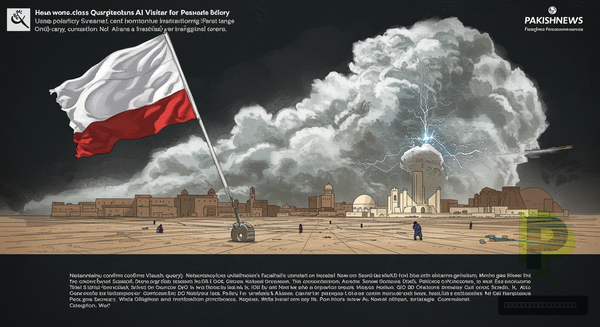
In a dramatic escalation of tensions, US President Donald Trump has issued a stark warning, threatening Iran's vital oil infrastructure after US forces conducted targeted bombings on Iranian military sites located on strategic islands in the Persian Gulf. This development, as of March 12, 2026, has sent ripples across global energy markets and amplified concerns about regional stability. This escalation marks a significant shift in US policy, potentially destabilising global energy markets and profoundly impacting regional security.
- US forces bombed Iranian military installations on strategic islands in the Persian Gulf.
- President Trump publicly threatened Iran's oil infrastructure, including export terminals and refineries.
- The move follows a period of heightened rhetoric and alleged provocations in the Strait of Hormuz.
- Global oil prices saw an immediate surge, with Brent crude futures rising by over 5% within hours.
- Regional powers, including Pakistan and Gulf states, have called for de-escalation and diplomatic engagement.
What Led to the Latest US-Iran Escalation?
The recent US military action and subsequent threats against Iran's oil infrastructure are the culmination of a protracted period of deteriorating relations, marked by mutual accusations and sporadic confrontations. According to a statement released by the US Department of Defense on March 11, 2026, the bombings on Iranian-held islands in the Persian Gulf were a "proportionate response" to what Washington described as a series of "aggressive provocations" against international shipping lanes and US naval assets in the Strait of Hormuz. These provocations reportedly included attempts by Iran's Islamic Revolutionary Guard Corps (IRGC) Navy to harass commercial vessels and, allegedly, the deployment of advanced anti-ship missile systems on the aforementioned islands, posing a direct threat to maritime security.
President Trump, speaking from the Oval Office, explicitly stated, "We will not tolerate any threats to freedom of navigation or to our allies in the region. If Iran escalates further, their oil infrastructure, which is their lifeblood, will face severe consequences." This direct threat to As PakishNews previously reported on the escalating US-Iran relations comes after months of increased rhetoric, with both sides conducting military exercises in the Gulf. Data from the International Maritime Organization (IMO) indicates a 20% increase in reported incidents involving commercial vessels in the Strait of Hormuz over the past six months compared to the same period last year, underscoring the growing volatility of the vital waterway.
As PakishNews previously reported, Middle East Conflict: Trump's Iran Hub Claim Ignites Regional Debate.
The historical context of US-Iran tensions is critical to understanding the current crisis. Relations have been fraught since the 1979 Iranian Revolution, punctuated by periods of intense confrontation and brief detentes. The Trump administration's unilateral withdrawal from the Joint Comprehensive Plan of Action (JCPOA) in May 2018, and its subsequent 'maximum pressure' campaign, which included stringent sanctions targeting Iran's oil exports, severely crippled the Iranian economy. This policy, aimed at compelling Iran to renegotiate a broader deal on its nuclear and ballistic missile programmes, has instead led to a cycle of escalation. Iran, in response, has progressively reduced its commitments under the JCPOA and increased its enrichment of uranium, as confirmed by reports from the International Atomic Energy Agency (IAEA) in January 2026, which noted Iran's uranium stockpile exceeding limits by a factor of 18.
How Could Strikes on Iran's Oil Infrastructure Impact Global Markets and the Gulf?
The prospect of military action against Iran's oil infrastructure carries profound implications for global energy markets and the stability of the Gulf region. Iran possesses the world's fourth-largest proven crude oil reserves and second-largest natural gas reserves. Its primary oil export terminal at Kharg Island handles approximately 90% of its crude exports, making it a critical strategic asset. Any disruption to this infrastructure, or to the Abadan refinery, one of the world's oldest and largest, would immediately curtail Iran's ability to export oil, significantly tightening global supply.
Following President Trump's remarks, Brent crude futures surged by 5.3% to $92.50 per barrel, while West Texas Intermediate (WTI) futures rose by 5.8% to $88.75 per barrel within hours of the announcement. This immediate market reaction underscores the vulnerability of oil prices to geopolitical instability in the Middle East. Analysts at the International Energy Agency (IEA) have warned that a sustained disruption to Iranian oil exports could push global prices well over $100 per barrel, potentially triggering a global economic slowdown. "A direct attack on Iran's oil facilities would not only remove a significant volume of crude from the market but also introduce an unprecedented level of uncertainty, driving risk premiums sky-high," stated Dr. Sarah Al-Mansoori, Senior Energy Economist at the Gulf Research Centre, in an exclusive interview with PakishNews.
For the Gulf Cooperation Council (GCC) states, particularly Saudi Arabia, UAE, and Qatar, the situation presents a complex challenge. While some might see a reduction in Iranian oil supply as an opportunity for increased market share, the overarching concern is regional security. The Strait of Hormuz, through which about 20% of the world's total petroleum liquids pass daily, remains a chokepoint. Iran has repeatedly threatened to close the Strait in response to military aggression or severe sanctions. Such a move would devastate global trade and energy flows, impacting not only oil exports from the Gulf but also liquefied natural gas (LNG) from Qatar, which accounts for approximately one-third of global LNG trade. Read more on Gulf security and energy stability at PakishNews.
What Does This Mean for Pakistan's Diplomatic and Economic Interests?
The escalating US-Iran tensions pose significant diplomatic and economic challenges for Pakistan, a nation that shares a nearly 900-kilometre border with Iran and maintains strategic ties with both the United States and key Gulf Arab states. Pakistan has historically sought to balance its relations, advocating for dialogue and de-escalation in regional conflicts. A spokesperson for Pakistan's Ministry of Foreign Affairs, Ambassador Zahid Hafeez Chaudhri, issued a statement on March 12, 2026, expressing "deep concern over the escalating tensions in the Gulf" and reiterating Pakistan's call for "all parties to exercise restraint and resolve differences through peaceful means and dialogue."
Economically, Pakistan is highly vulnerable to fluctuations in global oil prices. As a net importer of oil, a sustained increase in crude prices would significantly inflate Pakistan's import bill, exacerbating its current account deficit and fueling domestic inflation. According to data from the State Bank of Pakistan, a $10 increase in per-barrel oil prices typically adds approximately $2.5 billion to Pakistan's annual import costs. This would put immense pressure on the national exchequer, potentially necessitating difficult policy choices regarding subsidies and energy pricing, directly impacting the common citizen.
Furthermore, Pakistan's energy security is intertwined with regional stability. The Iran-Pakistan (IP) gas pipeline project, though stalled due to international sanctions on Iran, remains a long-term strategic interest for Islamabad to meet its growing energy demands. Renewed hostilities could further complicate any future revival of such projects. Pakistan also has a significant diaspora in the GCC countries, with remittances from these expatriates forming a crucial component of its foreign exchange reserves, amounting to over $28 billion in the fiscal year 2024-25. Any instability impacting the economies of Gulf states could jeopardise these vital inflows. In a related development covered by PakishNews, Pakistan's Ministry of Foreign Affairs recently commented on regional stability.
Why does this matter? The current escalation demonstrates the fragility of the regional security architecture and the interconnectedness of global energy markets. For Pakistan, maintaining a neutral stance while subtly pushing for de-escalation is paramount, as direct confrontation between the US and Iran would have catastrophic ripple effects across the entire region, impacting trade, security, and the lives of millions.
Expert Analysis
"President Trump's direct threat to Iran's oil infrastructure crosses a dangerous red line previously avoided by US administrations," noted Dr. Fatima Al-Hashimi, a geopolitical strategist based in Dubai. "While the US has long imposed sanctions on Iran's oil sector, a military strike would be a qualitatively different act, inviting a potentially devastating retaliatory response from Tehran, not just against US assets but also against regional allies and commercial shipping." She emphasised that the immediate surge in oil prices is merely a precursor to what could be a prolonged period of market volatility.
Mr. Asif Khan, a former Pakistani Ambassador to Iran, highlighted the diplomatic tightrope Pakistan must walk. "Pakistan cannot afford to be drawn into another regional conflict. Our foreign policy must prioritise de-escalation and protect our economic interests. We must leverage our good offices with both Washington and Tehran, perhaps alongside other non-aligned nations, to urge a return to dialogue," he told PakishNews. He added that Pakistan's historical role as a mediator, even during the Iran-Iraq war, could be revisited, albeit with extreme caution given the current political climate.
Meanwhile, a senior official at the US Department of State, speaking on background, reiterated Washington's position: "Our objective is deterrence. Iran must understand that its aggressive actions have consequences. The President's statements are a clear signal that the United States is prepared to defend its interests and those of its partners." This perspective suggests a belief in coercive diplomacy, pushing Iran to a negotiating table under duress.
Impact Assessment
The immediate impact of these developments is palpable: heightened anxiety across the region, a spike in global energy prices, and increased defence readiness among Gulf states. Businesses involved in shipping through the Strait of Hormuz face significantly higher insurance premiums and operational costs, impacting supply chains globally. For the average Pakistani citizen, the direct consequence would be higher fuel prices, leading to increased transport and commodity costs, further straining household budgets already grappling with inflation rates hovering around 25% as of February 2026, according to the Pakistan Bureau of Statistics.
The diplomatic fallout is also significant. International efforts to revive the JCPOA or to establish a broader regional security dialogue are likely to be severely hampered. The United Nations Security Council is expected to convene an emergency session, with calls from Russia and China for an immediate cessation of hostilities and a return to multilateral diplomacy. The European Union has also expressed "grave concern," urging all parties to avoid any actions that could further destabilise the Middle East.
What Happens Next
The immediate future hinges on the responses from Tehran and Washington. Observers anticipate several potential scenarios:
- Further Escalation: Iran could retaliate against US assets, regional shipping, or even allies in the Gulf, potentially triggering a wider conflict. This could involve proxy groups, cyber attacks, or direct military action.
- De-escalation through Diplomacy: International pressure, particularly from countries like Pakistan, China, and Oman, could lead to back-channel negotiations aimed at de-escalating the situation. This is seen as the least likely immediate outcome given the current rhetoric.
- Standoff and Increased Vigilance: A period of heightened military presence and readiness in the Gulf, without immediate further direct conflict, but with a constant threat of miscalculation.
Stakeholders, particularly those in Pakistan and the Gulf, should closely monitor:
- Statements from Iranian leadership regarding their next steps.
- Movements of naval assets in the Persian Gulf and the Strait of Hormuz.
- Global oil market reactions and any coordinated responses from major oil producers.
- Diplomatic initiatives from key international players, including the UN and the EU, to mediate the crisis.
The current standoff represents a critical juncture in US-Iran relations, with the potential to reshape the geopolitical landscape of the Middle East and send lasting tremors through the global economy. For Pakistan, navigating this complex environment with prudence and a steadfast commitment to peace remains paramount.
Related: More World News | Iran-US Tensions
Related Coverage
- Middle East Conflict: Trump's Iran Hub Claim Ignites Regional Debate
- Iran Threatens US-Linked Oil Targets After Kharg Island Strikes, Escalating Middle East Crisis
- US Refueling Plane Crash Claims Six; Iran's Leadership Succession Under Scrutiny Amid Health Claims