Listen to this articlePress play to hear this story in conversational podcast format.Listen to this articleDownload audio
Islamabad is closely monitoring a rapidly escalating crisis in the Middle East, where a series of targeted strikes on Gulf energy infrastructure and reports of high-profile casualties have sent global oil prices surging. This volatile regional backdrop coincides with significant claims regarding Pakistan’s strategic defence capabilities and a notable surge in the Pakistan Stock Exchange (PSX), creating a multifaceted challenge for policymakers in Islamabad and Karachi as of March 19, 2026. The confluence of these events demands a nuanced understanding of their immediate and long-term implications for national security, economic stability, and foreign policy.
Quick Answer
Middle East conflict intensifies, pushing oil prices up, as reports claim Pakistan-China nuclear missile development. Pakistan's economy faces dual pressures of external instability and domestic market shifts.
- How do rising oil prices from the Middle East conflict directly affect Pakistan's economy? Rising global oil prices directly increase Pakistan's import bill, as the nation is a net importer of crude oil. This leads to higher domestic fuel prices, which in turn drive up transportation costs, manufacturing expenses, and overall inflation for essential goods and services. For instance, a 7% increase in global crude oil benchmarks, as observed on March 19, 2026, can significantly strain Pakistan's foreign exchange reserves and exacerbate its balance of payments challenges.
- What are the implications for Pakistan of the reported China-Pakistan nuclear missile development? The reported joint development of nuclear-capable missiles by China and Pakistan, with a range extending to the United States, implies a significant enhancement of Pakistan's strategic deterrence capabilities and a deepening of its defence partnership with China. This development could reshape regional security dynamics, potentially influencing Pakistan's foreign policy and its relationships with major global powers. It signals a robust commitment to national defence, aligning with Pakistan's long-standing policy of maintaining a credible minimum deterrence, as articulated by defence analysts like Dr. Aisha Khan.
- How does instability in the Gulf region impact Pakistani expatriates and remittances? Instability in the Gulf region directly threatens the safety and economic well-being of the estimated 4.5 million Pakistani expatriates working there. Increased conflict can disrupt economic activity, leading to job losses or reduced income, which in turn impacts the flow of remittances back to Pakistan. Given that remittances from GCC countries constituted over 60% of Pakistan's total remittances exceeding $30 billion in 2025, any sustained disruption could severely affect Pakistan's foreign exchange reserves and the financial stability of countless families.
- Middle East conflict intensifies with strikes on Gulf energy sites, including a major Qatar gas hub, leading to a significant spike in global oil prices.
- Iran's intelligence minister was reportedly killed by an Israeli strike, with Tehran vowing retaliation, further deepening regional instability.
- A report from an unnamed intelligence chief suggests China and Pakistan are jointly developing nuclear-capable missiles capable of reaching the United States.
- The Pakistan Stock Exchange (PSX) experienced a notable upward trend, driven by renewed investor interest, despite external geopolitical uncertainties.
- Gulf states, including the UAE, Saudi Arabia, Qatar, Bahrain, and Kuwait, have announced the official date for Eid al-Fitr, impacting millions of expatriate Pakistanis.
Key Takeaway: Pakistan faces a critical juncture where regional instability, strategic defence advancements, and domestic economic shifts demand a comprehensive policy response to safeguard national interests and ensure energy security.
As PakishNews previously reported, Escalating Middle East Crisis Threatens Global Energy, but How Will Pakistan….
Escalating Middle East Conflict and Global Oil Volatility
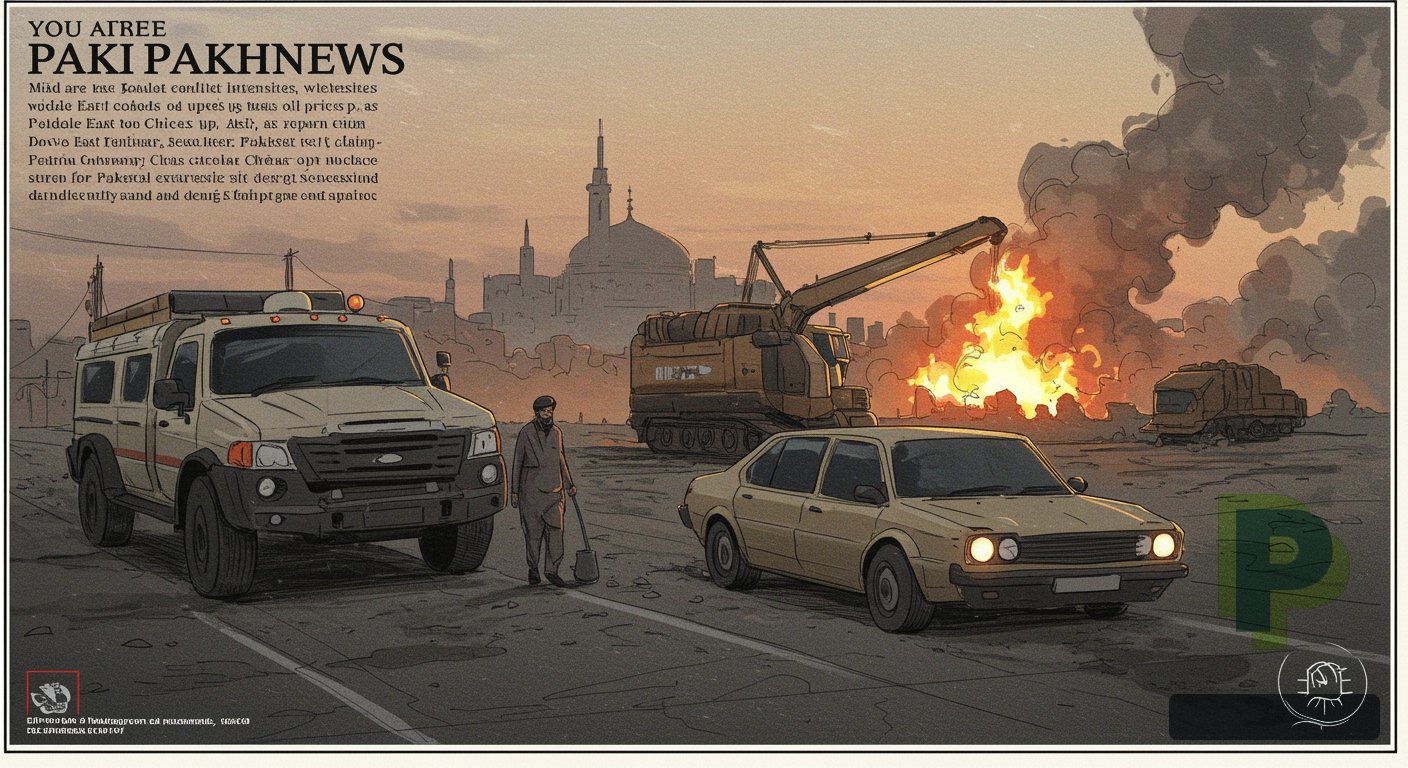
The Middle East plunged into deeper turmoil over the past 24 hours, marked by a series of aggressive military actions that have directly impacted energy markets. According to reports from The New York Times and CNN, several Gulf energy sites were struck, including a major gas hub in Qatar, triggering significant fires and a sharp spike in global oil prices. Crude oil benchmarks rose by approximately 7% in early trading, reaching their highest levels in over a year, a development that poses immediate challenges for energy-importing nations like Pakistan. This escalation follows earlier reports from NBC News confirming the killing of Iran’s intelligence minister in an alleged Israeli strike, an event that Tehran has vowed to avenge, as stated by The Guardian. The Pentagon has reportedly requested an additional $200 billion in funds for the ongoing Iran conflict, signalling a potentially prolonged and costly engagement for the United States.
The direct targeting of energy infrastructure in the Gulf, a critical global supply artery, underscores the widening scope of the conflict. For Pakistan, which relies heavily on imported oil to fuel its economy, this translates into an immediate increase in import bills and inflationary pressures. The State Bank of Pakistan’s latest economic outlook, released in February 2026, had projected a stable energy import cost scenario, but these new developments could significantly disrupt those forecasts. Rising global oil prices directly impact transportation costs, manufacturing inputs, and ultimately, consumer prices for essential goods, potentially eroding any domestic economic gains. Furthermore, the safety and economic well-being of the millions of Pakistani expatriates working in the Gulf Cooperation Council (GCC) countries, who are crucial contributors to Pakistan's foreign exchange reserves through remittances, become a paramount concern amidst such instability.
Pakistan’s Strategic Depth Amidst Regional Shifts
Amidst the regional conflagration, a significant report emerged concerning Pakistan's strategic defence capabilities. NDTV cited an unnamed intelligence chief claiming that China and Pakistan are jointly developing nuclear-capable missiles with a range sufficient to put the United States within reach. While specific details remain unconfirmed by official Pakistani or Chinese sources, this report, if accurate, signals a deepening of the strategic partnership between Beijing and Islamabad and has profound implications for global and regional power dynamics. It positions Pakistan as a more formidable player in the complex calculus of international security, potentially altering perceptions in Washington and other global capitals regarding Pakistan's defence posture.
Why does this matter? This development, even as a reported claim, underscores Pakistan’s commitment to maintaining a credible minimum deterrence against evolving security threats. It also highlights the enduring strategic alignment with China, a partnership that extends beyond economic cooperation, such as the China-Pakistan Economic Corridor (CPEC), into critical defence technology. A senior analyst at the Islamabad Policy Research Institute, Dr. Aisha Khan, noted, "Such reports, regardless of their immediate verification, reshape geopolitical narratives. They signal a qualitative leap in Pakistan's strategic autonomy and its ability to project power, which will undoubtedly be factored into regional security dialogues and global arms control discussions." This reported advancement comes at a time when Pakistan is navigating complex relationships with its neighbours and major global powers, including the United States, which has historically been a key defence partner.
Economic Resilience and Regional Interdependencies
Despite the shadow of regional conflict, Pakistan's domestic financial market showed signs of resilience. According to The Express Tribune, the Pakistan Stock Exchange (PSX) soared on renewed investor interest, reflecting a degree of domestic confidence. The KSE-100 index gained over 800 points, or approximately 1.8%, during Wednesday's trading session, driven by positive sentiment on certain corporate earnings and anticipation of potential economic reforms. This surge, however, stands in stark contrast to the external economic pressures emanating from the Middle East crisis. While local factors might be boosting investor confidence, the sustained increase in global oil prices and the potential disruption to trade routes could pose significant headwinds.
The impact of the Middle East crisis on Pakistan's economy is multi-layered. Beyond the direct cost of energy imports, a prolonged conflict could destabilize the entire Gulf region, potentially affecting remittances from Pakistani expatriates. In 2025, remittances from the GCC countries accounted for over 60% of Pakistan’s total remittances, which exceeded $30 billion. Any disruption to this flow would severely strain Pakistan's balance of payments and foreign exchange reserves. Furthermore, Pakistan's trade relations with the Gulf, particularly for agricultural products and textiles, could face logistical challenges and increased insurance costs for shipping. "The PSX surge is a welcome domestic indicator, but it exists in a globalised economy," stated Mr. Bilal Ahmed, an economic commentator at the Lahore University of Management Sciences. "Policymakers must look beyond immediate market gains and prepare contingency plans for sustained oil price volatility and potential downturns in remittance inflows, which are vital for our economic stability."
Eid al-Fitr Announcement and Diaspora Concerns
In a separate but culturally significant development, Gulf states, including the UAE, Saudi Arabia, Qatar, Bahrain, and Kuwait, officially announced the date for Eid al-Fitr, marking the end of Ramadan. As reported by Al Watan, the announcement confirmed the holiday for the Muslim world, bringing spiritual anticipation to millions. For the estimated 4.5 million Pakistanis residing and working in these GCC countries, this announcement is a key part of their cultural and religious calendar, often involving travel and family gatherings. However, this year's celebrations will be tinged with apprehension due to the escalating regional tensions. The safety and security of these expatriate communities are paramount, and any further destabilization could lead to calls for repatriation or increased welfare support from the Pakistani government.
The Pakistani government, through its missions in the Gulf, is likely to be on high alert, providing advisories and support to its citizens. The prospect of increased conflict in the region could impact travel plans and the ability of expatriates to send remittances home, especially if economic activity in the Gulf is disrupted. This situation underscores the deep interconnectedness of Pakistan with the Gulf region, not just economically but also culturally and through its large diaspora. As PakishNews previously reported on the challenges faced by Pakistani workers abroad, the current crisis adds another layer of complexity to their circumstances.
What Happens Next: Navigating a Turbulent Future
The coming days and weeks will be critical in determining the trajectory of the Middle East conflict and its fallout. Observers will be watching for Iran's retaliatory measures following the reported killing of its intelligence minister, which could further escalate hostilities and potentially draw in more regional and international actors. The impact on global oil prices is likely to be sustained, pushing Pakistan to consider alternative energy procurement strategies and accelerate its domestic energy reforms. The government may need to explore options for strategic oil reserves, diversify energy sources, and enhance diplomatic efforts to de-escalate regional tensions.
On the strategic front, the report concerning Pakistan and China's missile development will likely prompt increased scrutiny from international defence analysts and policymakers. Pakistan's foreign policy will be challenged to balance its strategic partnerships with its need to maintain diplomatic ties across the spectrum of global powers, particularly with the United States and European nations. The Ministry of Foreign Affairs will need to articulate Pakistan's position clearly on these complex defence matters while advocating for regional peace and stability. In a related development covered by PakishNews on the expanding scope of Pakistan-China cooperation, this missile report adds a significant dimension.
For the economy, the State Bank of Pakistan and the Ministry of Finance will need to reassess inflation targets and fiscal policies in light of potential energy shocks and remittance fluctuations. Measures to support the PSX and maintain investor confidence will be crucial, but these must be anchored in realistic assessments of external risks. The government might also consider enhanced welfare programmes for expatriates in the Gulf and prepare for potential repatriation scenarios, though such measures would be a last resort. Read more on Pakistan's economic challenges at PakishNews.
Ultimately, Pakistan finds itself at a pivotal moment, where its national security and economic prosperity are intricately linked to developments far beyond its borders. The ability of its leadership to navigate these converging crises—from geopolitical tensions and strategic defence enhancements to economic vulnerabilities and diaspora welfare—will define the nation's trajectory in 2026 and beyond. Stakeholders, from policymakers to business leaders and informed citizens, should closely monitor the Middle East for signs of de-escalation or further intensification, watch global oil markets for sustained trends, and observe Pakistan's diplomatic engagements for strategic realignments.
Related Coverage
- Escalating Middle East Crisis Threatens Global Energy, but How Will Pakistan Navigate its Economic…
- Akhtar's Recent No-Ball Echoes Amir's Past, but what does this mean for PCB's integrity efforts in…
- Gulf States Confirm Eid al-Fitr Dates, but How Will Escalating Regional Tensions Impact Pakistan’s…
Archive Discovery
Frequently Asked Questions
How do rising oil prices from the Middle East conflict directly affect Pakistan's economy?
Rising global oil prices directly increase Pakistan's import bill, as the nation is a net importer of crude oil. This leads to higher domestic fuel prices, which in turn drive up transportation costs, manufacturing expenses, and overall inflation for essential goods and services. For instance, a 7% increase in global crude oil benchmarks, as observed on March 19, 2026, can significantly strain Pakistan's foreign exchange reserves and exacerbate its balance of payments challenges.
What are the implications for Pakistan of the reported China-Pakistan nuclear missile development?
The reported joint development of nuclear-capable missiles by China and Pakistan, with a range extending to the United States, implies a significant enhancement of Pakistan's strategic deterrence capabilities and a deepening of its defence partnership with China. This development could reshape regional security dynamics, potentially influencing Pakistan's foreign policy and its relationships with major global powers. It signals a robust commitment to national defence, aligning with Pakistan's long-standing policy of maintaining a credible minimum deterrence, as articulated by defence analysts like Dr. Aisha Khan.
How does instability in the Gulf region impact Pakistani expatriates and remittances?
Instability in the Gulf region directly threatens the safety and economic well-being of the estimated 4.5 million Pakistani expatriates working there. Increased conflict can disrupt economic activity, leading to job losses or reduced income, which in turn impacts the flow of remittances back to Pakistan. Given that remittances from GCC countries constituted over 60% of Pakistan's total remittances exceeding $30 billion in 2025, any sustained disruption could severely affect Pakistan's foreign exchange reserves and the financial stability of countless families.