Listen to ArticlePress play to hear this storyListen to ArticleDownload audio
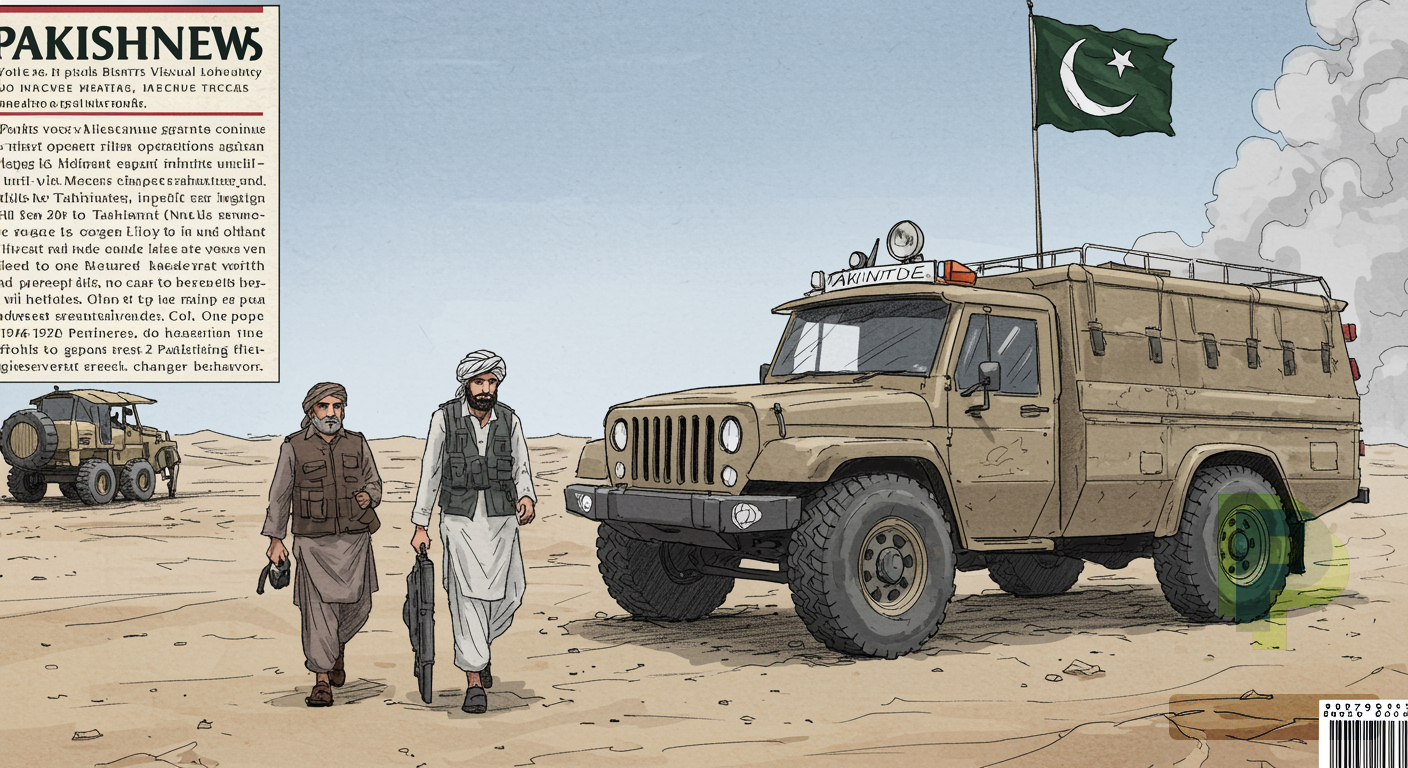
Pakistan has unequivocally stated that its military operations targeting militants operating from Afghan soil will persist until the interim Taliban government in Afghanistan demonstrates a tangible change in behaviour regarding cross-border terrorism. This firm stance, articulated by top Pakistani officials, signals a significant hardening of Islamabad's defence policy and raises immediate questions about the future of bilateral relations and regional stability. This development underscores Pakistan's heightened security concerns and its commitment to safeguarding its territorial integrity against a persistent militant threat.
Quick Answer
Pakistan vows to continue military operations against Afghan-origin militants until the Taliban changes its behaviour, escalating regional tensions and impacting vital border trade.
- What specific 'behaviour change' is Pakistan demanding from the Afghan Taliban? Pakistan is primarily demanding that the Afghan Taliban interim government take verifiable and concrete action to dismantle safe havens for militant groups, particularly the Tehrik-i-Taliban Pakistan (TTP), on Afghan soil. This includes preventing the use of Afghan territory for planning or executing attacks against Pakistan, extraditing wanted terrorists, and ceasing all forms of support to such groups. This demand stems from a significant increase in cross-border militant attacks, with Pakistan reporting a 60% rise in attacks in 2023 compared to the previous year.
- How do Pakistan's military operations impact bilateral trade with Afghanistan? Pakistan's military operations and the resulting heightened border security significantly impact bilateral trade with Afghanistan, particularly through vital crossings like Torkham. Disruptions, closures, and increased scrutiny can lead to substantial delays, raise operational costs for traders, and reduce the overall volume of goods exchanged. In late 2023, border closures caused losses of millions of rupees, affecting thousands of livelihoods and potentially impacting food security for both nations, which collectively conduct trade worth approximately $1.5 billion annually.
- What are the broader regional implications of Pakistan's intensified military stance? Pakistan's intensified military stance carries significant broader regional implications, potentially affecting stability in South Asia and its relations with key partners. Regional countries like China, heavily invested in the China-Pakistan Economic Corridor (CPEC), are concerned about any escalation that could jeopardise their projects. Furthermore, a prolonged conflict could destabilise Afghanistan further, exacerbating humanitarian crises and potentially creating vacuums for other extremist groups, drawing international scrutiny and complicating Pakistan's diplomatic efforts with global powers like the United States and European Union.
- Pakistan confirms ongoing military operations against militant groups originating from Afghanistan.
- The operations will continue until the Afghan Taliban government alters its 'behaviour' concerning cross-border terrorism.
- This policy signifies a major shift in Pakistan's approach to border security and diplomatic engagement with Kabul.
- Concerns persist regarding the Tehrik-i-Taliban Pakistan (TTP) and its alleged sanctuary in Afghanistan.
- The decision has significant implications for regional trade, humanitarian efforts, and the broader security landscape.
The declaration, made public in early March 2026 following high-level security meetings in Islamabad, reinforces a growing impatience within Pakistan's defence establishment over what it perceives as a lack of concrete action by the Afghan Taliban to address the threat posed by various militant outfits, most notably the Tehrik-i-Taliban Pakistan (TTP). According to a statement issued by the Foreign Office of Pakistan on March 7, 2026, "Pakistan's patience is not limitless. We expect our neighbours to fulfil their commitments under international law and the Doha Agreement to not allow their territory to be used against any other country." This official communication, widely reported by state media outlets like the Associated Press of Pakistan (APP), highlights the diplomatic frustration underpinning the military posture.
As PakishNews previously reported, Macau Robot Incident Raises Public Safety Questions, But What Are the….
Background: A Deteriorating Security Landscape
The current policy directive is a culmination of a rapidly deteriorating security situation along Pakistan's western border, particularly in Khyber Pakhtunkhwa (KP) and Balochistan provinces. Since the Afghan Taliban's return to power in August 2021, Pakistan has witnessed a significant surge in terrorist attacks. Data from the Pakistan Institute for Peace Studies (PIPS) indicates a more than 60% increase in militant attacks across Pakistan in 2023 compared to the previous year, with a substantial portion attributed to groups operating from or having links to Afghanistan. These attacks, often targeting security forces and civilian infrastructure, have resulted in hundreds of casualties, including 389 security personnel in 2023 alone, according to Interior Ministry figures released in January 2024. The TTP, a proscribed terrorist organisation, has frequently claimed responsibility for these assaults, exploiting what Pakistani authorities describe as safe havens across the 2,670-kilometre border.
Historically, the border region has been volatile. Pakistan has undertaken multiple large-scale military operations, such as Zarb-e-Azb (2014) and Radd-ul-Fasaad (2017), to clear its tribal areas of militants. However, the porous nature of the Durand Line and the shifting geopolitical dynamics post-2021 have presented new challenges. Islamabad's position has consistently been that the Afghan Taliban, as the de facto rulers of Afghanistan, bear the responsibility to prevent their territory from being used for cross-border terrorism, a commitment enshrined in the Doha Agreement between the Taliban and the United States. The Afghan Taliban, however, have repeatedly denied these allegations, asserting that they are committed to not allowing their soil to be used against others and have claimed to be actively combating militant groups within Afghanistan. This divergence in narrative and perceived action forms the crux of the current diplomatic and security impasse.
Escalating Tensions and Diplomatic Stalemate
The recent declaration by Pakistan represents a strategic shift from primarily diplomatic channels and border management efforts to a more assertive military stance. According to a senior government official, who spoke to PakishNews on condition of anonymity due to the sensitivity of the matter, "Years of dialogue and appeals have not yielded the desired results. We have provided irrefutable evidence of TTP's presence and activities in Afghanistan, yet the attacks continue. This necessitates a proactive defence of our citizens and our borders." This sentiment echoes across various government and military echelons, reflecting a collective determination to address the perceived threat decisively. The official further elaborated that the 'behaviour change' sought from the Taliban government includes concrete steps to dismantle TTP sanctuaries, extradite wanted terrorists, and cease all forms of support, direct or indirect, to groups hostile to Pakistan.
The Afghan Taliban's interim government, through its spokesperson Zabihullah Mujahid, has countered Pakistan's claims, stating that "Afghanistan's soil is not being used against any country, and we are committed to this principle." Mujahid, in a statement reported by TOLOnews on March 9, 2026, urged Pakistan to resolve issues through dialogue rather than military actions, which he warned could destabilise the region. This exchange highlights the deep mistrust and communication breakdown between the two neighbours, complicating any potential de-escalation efforts. The Pakistani government's decision to continue operations until behaviour change suggests a long-term commitment, potentially extending the period of heightened tension indefinitely if Kabul's posture remains unchanged.
Expert Analysis: Risks and Regional Realities
Security analysts and former diplomats offer varied perspectives on Pakistan's assertive stance. Dr. Ayesha Siddiqa, a senior security analyst based in Islamabad, told PakishNews, "Pakistan's decision is a calculated risk. While it sends a strong message of resolve, it also risks further alienating the Afghan Taliban and potentially escalating a low-intensity conflict into something more significant. The key will be to define what 'behaviour change' truly means and how it can be verifiably demonstrated." Dr. Siddiqa emphasised the need for clear benchmarks to prevent an open-ended military engagement.
Ambassador (Retd.) Jamshed Khan, a former diplomat with extensive experience in regional affairs, commented, "This policy is a reflection of domestic pressures and genuine security concerns. The Pakistani public expects decisive action against terrorism. However, a purely military solution without concurrent robust diplomatic engagement might prove counterproductive in the long run. Regional stability requires a cooperative framework, and alienating Afghanistan further could push them towards other regional actors." Ambassador Khan, speaking from Karachi, highlighted the delicate balance Pakistan must maintain between asserting its security interests and fostering regional peace.
Meanwhile, Dr. Hassan Askari Rizvi, a prominent defence and political analyst, noted, "The international community, while sympathetic to Pakistan's counter-terrorism efforts, also remains cautious about actions that could destabilise Afghanistan further. Pakistan needs to articulate its strategy clearly to global partners, ensuring it aligns with international norms and avoids a humanitarian crisis. The economic impact on border communities, particularly those involved in cross-border trade, is a significant concern that requires careful management." Dr. Rizvi's comments, shared during a recent seminar in Lahore, underscore the multifaceted challenges Pakistan faces.
Why does this matter? The continuation of military operations against targets in Afghanistan represents a significant escalation in Pakistan's counter-terrorism strategy, moving beyond defensive border management to a more proactive posture. This matters because it directly impacts regional stability, the lives of millions residing along the border, and the delicate diplomatic balance in South Asia. A prolonged military engagement could strain Pakistan's economy, already facing significant challenges, and complicate its relations with key international partners, potentially leading to further regional isolation for Afghanistan.
The Economic and Humanitarian Calculus: Impact on Torkham and Beyond
The immediate implications of Pakistan's intensified military operations are acutely felt at key border crossings, such as Torkham in Khyber Pakhtunkhwa. Torkham, one of the busiest land ports between Pakistan and Afghanistan, is a vital artery for bilateral trade, facilitating the movement of goods worth billions of rupees annually. According to data from the Pakistan Customs, bilateral trade between Pakistan and Afghanistan, while fluctuating, averaged approximately $1.5 billion annually over the past five years. Any disruption to the flow of goods through Torkham, whether due to security concerns, temporary closures, or increased scrutiny, directly impacts the livelihoods of thousands of traders, transporters, and daily wage earners on both sides of the border.
As PakishNews previously reported on the challenges facing Pak-Afghan trade, prolonged military activities and heightened border security measures can lead to significant delays, increased operational costs, and a reduction in trade volume. For instance, in periods of heightened tension in late 2023, the Torkham border crossing experienced closures lasting several days, leading to losses estimated at millions of rupees for traders, particularly those dealing in perishable goods. The current policy, if it leads to sustained insecurity or intermittent border closures, could severely disrupt agricultural exports from Pakistan and imports of fresh produce from Afghanistan, affecting market prices and food security in both nations. A recent survey by the Sarhad Chamber of Commerce and Industry (SCCI) indicated that a 10% reduction in trade volume through Torkham could lead to job losses for nearly 5,000 individuals in the border region alone.
Beyond economics, the humanitarian dimension is critical. The border regions host significant populations of Afghan refugees and internally displaced persons. Increased military activity, even if precisely targeted, always carries the risk of unintended consequences, potentially leading to further displacement or hindering humanitarian aid efforts. Organisations like the United Nations High Commissioner for Refugees (UNHCR) have consistently called for the protection of civilians and unhindered access for humanitarian assistance in the region. Pakistan's strategy must, therefore, balance its security imperatives with its humanitarian obligations, especially given its long history of hosting millions of Afghan refugees.
Regional Repercussions and International Scrutiny
The decision to continue military operations until the Afghan Taliban 'changes behaviour' carries significant regional repercussions, extending beyond the immediate Pakistan-Afghanistan dynamic. Pakistan's actions are closely watched by its allies and regional partners, including China, Iran, and the Central Asian states. China, a key investor in Pakistan through the China-Pakistan Economic Corridor (CPEC), has consistently expressed concerns about regional stability and the potential for spillover of militancy. Any prolonged instability on Pakistan's western flank could impact the security of CPEC projects, particularly those in Balochistan and Khyber Pakhtunkhwa, which are vital for Pakistan's economic future. In a related development covered by PakishNews, security measures for CPEC projects have been intensified in recent months.
Internationally, Pakistan's stance will be scrutinised for its adherence to international law and its potential impact on Afghanistan's already fragile humanitarian situation. While many global powers acknowledge Pakistan's legitimate security concerns, there is also a shared apprehension about actions that could further destabilise Afghanistan, potentially creating a vacuum for other extremist groups or exacerbating the humanitarian crisis. The United States and European Union have consistently urged regional states to engage constructively with the Afghan Taliban to address security challenges, while also pressing the Taliban on human rights and counter-terrorism commitments. Pakistan's current approach, therefore, places it at a critical juncture, navigating its national security interests within a complex web of regional and international expectations.
The risk of a tit-for-tat escalation also looms. While Pakistan maintains its operations are defensive, any perceived incursions into Afghan territory could provoke retaliatory actions from the Afghan Taliban, further intensifying border clashes and potentially drawing in local non-state actors. This could transform localised skirmishes into a more protracted and widespread conflict, with devastating consequences for a region already grappling with decades of instability. The long-term economic burden of sustained military operations, including increased defence spending and potential disruption to trade routes, would also be a significant challenge for Pakistan's economy, which is currently undergoing a difficult period of fiscal consolidation. Read more on Pakistan's economic outlook at PakishNews.
What Happens Next: Navigating a Precarious Path
Moving forward, the situation demands a multi-pronged approach from Pakistan. Militarily, the operations are expected to continue with precision targeting against identified militant hideouts and infrastructure. However, the efficacy of such operations in achieving a fundamental 'behaviour change' from the Afghan Taliban remains a subject of debate among experts. The Afghan Taliban's internal dynamics and their relationship with groups like the TTP are complex, making a swift and decisive shift in their policy challenging.
Diplomatically, Pakistan will likely continue to engage with regional and international partners to build consensus on the need for the Afghan Taliban to honour their counter-terrorism commitments. This includes leveraging forums like the Organisation of Islamic Cooperation (OIC) and bilateral discussions with countries like China, Iran, and Qatar, which maintain communication channels with Kabul. The challenge will be to find a diplomatic off-ramp that allows both sides to save face while effectively addressing Pakistan's core security concerns. Observers will be watching for any signs of direct, high-level engagement between Islamabad and Kabul, potentially facilitated by third parties, which could signal a willingness to de-escalate.
Economically, the government will need to implement measures to mitigate the impact of border disruptions on trade and local economies. This could include exploring alternative trade routes, establishing dedicated economic support packages for border communities, and streamlining customs procedures to minimise delays when borders are open. For citizens, particularly those residing in border areas, the immediate future may involve continued vigilance and adaptation to evolving security protocols.
The coming months will be critical in determining the trajectory of Pakistan-Afghanistan relations and the broader security landscape in South Asia. Stakeholders should closely watch for concrete actions from the Afghan Taliban regarding counter-terrorism, the frequency and intensity of cross-border incidents, and the nature of diplomatic engagements between Islamabad and Kabul. The path ahead is precarious, demanding both strategic resolve and diplomatic dexterity from Pakistan to secure its borders while fostering regional stability.
Related: More Pakistan News | Afghanistan Conflict
Related Coverage
- Macau Robot Incident Raises Public Safety Questions, But What Are the Implications for Gulf Smart…
- PIA Suspends Fujairah Flights Amid Gulf Tensions, but What is the Wider Impact on Karachi Air…
- Pakistan's Solar Surge Boosts Energy Resilience, but What Does This Mean for Karachi's Power…
Archive Discovery
Quick Answers (AI Overview)
- What happened in this story?
Pakistan has unequivocally stated that its military operations targeting militants operating from Afghan soil will persist until the interim Taliban government in Afghanistan demonstrates a tangible change in behaviour r - Why does this matter right now?
It matters because pakistan affirms continued military operations against afghan-origin militants, but what are the immediate implications for cross-border trade in torkham? can impact public discussion, policy, or regional stability depending on follow-up events. - What should readers watch next?
Watch for official statements, verified facts, and timeline updates from credible sources including Arab News PK.
Frequently Asked Questions
What specific 'behaviour change' is Pakistan demanding from the Afghan Taliban?
Pakistan is primarily demanding that the Afghan Taliban interim government take verifiable and concrete action to dismantle safe havens for militant groups, particularly the Tehrik-i-Taliban Pakistan (TTP), on Afghan soil. This includes preventing the use of Afghan territory for planning or executing attacks against Pakistan, extraditing wanted terrorists, and ceasing all forms of support to such groups. This demand stems from a significant increase in cross-border militant attacks, with Pakistan reporting a 60% rise in attacks in 2023 compared to the previous year.
How do Pakistan's military operations impact bilateral trade with Afghanistan?
Pakistan's military operations and the resulting heightened border security significantly impact bilateral trade with Afghanistan, particularly through vital crossings like Torkham. Disruptions, closures, and increased scrutiny can lead to substantial delays, raise operational costs for traders, and reduce the overall volume of goods exchanged. In late 2023, border closures caused losses of millions of rupees, affecting thousands of livelihoods and potentially impacting food security for both nations, which collectively conduct trade worth approximately $1.5 billion annually.
What are the broader regional implications of Pakistan's intensified military stance?
Pakistan's intensified military stance carries significant broader regional implications, potentially affecting stability in South Asia and its relations with key partners. Regional countries like China, heavily invested in the China-Pakistan Economic Corridor (CPEC), are concerned about any escalation that could jeopardise their projects. Furthermore, a prolonged conflict could destabilise Afghanistan further, exacerbating humanitarian crises and potentially creating vacuums for other extremist groups, drawing international scrutiny and complicating Pakistan's diplomatic efforts with global powers like the United States and European Union.