
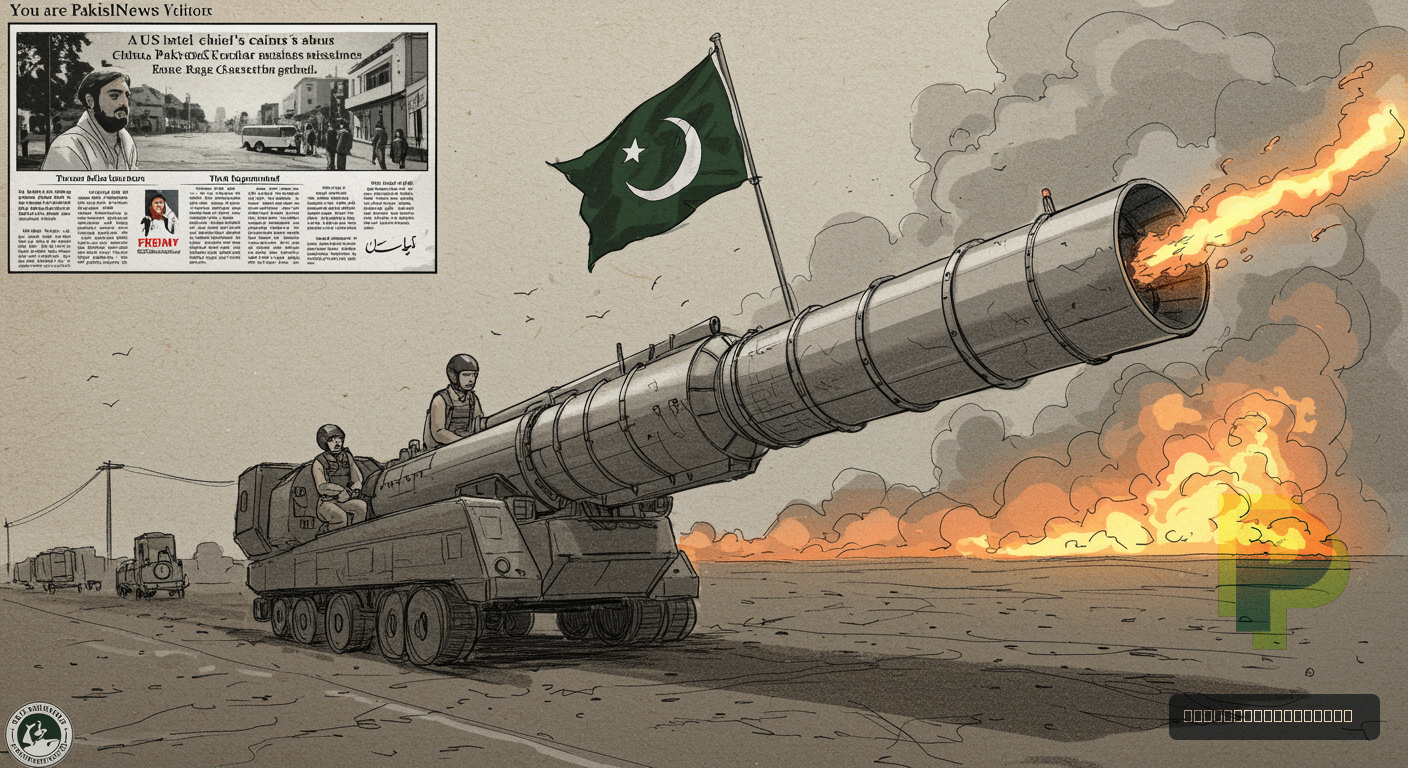
Listen to ArticlePress play to hear this storyListen to ArticleDownload audioA recent statement by a US intelligence chief, as reported by Indian media outlet NDTV, has ignited a significant discussion regarding alleged joint development of nuclear missiles by China and Pakistan, potentially capable of reaching the United States. This development, if confirmed, carries profound implications for global strategic stability and Pakistan's defence posture, prompting a re-evaluation of regional power dynamics and international security frameworks. The claims underscore an evolving strategic landscape that could redefine defence policies for multiple global powers, necessitating careful diplomatic navigation by Islamabad.
- A US intelligence chief reportedly claimed China and Pakistan are jointly developing nuclear missiles with US-range capabilities.
- The statement, as reported by NDTV, has not been officially confirmed by either China or Pakistan.
- Analysts suggest such a development, if true, would significantly alter global strategic deterrence and regional security in South Asia.
- Pakistan's strategic partnerships and defence modernisation efforts are under renewed international scrutiny.
- The claims necessitate a detailed assessment of their geopolitical ramifications for Pakistan's foreign policy and economic stability.
As of March 2026, the claims, attributed to an unnamed US intelligence official and widely disseminated by NDTV, suggest a deepening of defence cooperation between Beijing and Islamabad that extends beyond previously understood parameters. While the specifics of the missile systems or their operational status remain unverified by independent sources or official statements from China or Pakistan, the mere assertion by a US intelligence figure is sufficient to trigger international discourse and strategic planning. This report follows years of well-documented strategic collaboration between China and Pakistan, particularly in defence and nuclear technology, which has historically been a cornerstone of their bilateral relationship since the 1960s.
Quick Answer
A US intel chief's claims about China-Pak nuclear missiles reaching the US spark global concern, raising questions about Pakistan's strategic future.
- What is the alleged claim about China and Pakistan's missile development? According to reports by NDTV, a US intelligence chief has claimed that China and Pakistan are jointly developing nuclear missiles that possess the capability to reach the United States. This assertion, while unconfirmed by official sources from Beijing or Islamabad, suggests a significant advancement in their defence collaboration, potentially altering the global strategic balance and extending Pakistan's traditional defence perimeter.
- How might this development impact Pakistan's international relations? If substantiated, this reported development could intensify scrutiny on Pakistan's nuclear programme and its strategic partnerships, particularly with China. It could lead to increased diplomatic pressure from Western nations, potentially affecting economic aid, technology transfers, and foreign investment, especially given Pakistan's current economic challenges with a national debt exceeding 80% of its GDP as of late 2025. Islamabad would need to navigate these pressures while upholding its sovereign defence interests and commitment to non-proliferation.
- What are the broader regional implications for South Asia? The claims carry significant implications for South Asian regional stability, potentially accelerating an arms race between India and Pakistan. Such a development could compel India to further enhance its own missile defence systems and strategic alliances, thereby increasing the risk of miscalculation or escalation in the subcontinent. This situation would necessitate renewed diplomatic efforts and confidence-building measures to maintain the delicate balance of deterrence that has been in place since 1998.
Background: A Legacy of Strategic Partnership and Evolving Defence Postures
The strategic partnership between China and Pakistan has been a consistent feature of Asian geopolitics for decades. This cooperation spans economic, political, and defence sectors, often characterised by the phrase 'all-weather strategic cooperative partnership.' In the defence realm, this has translated into joint military exercises, technology transfers, and collaboration on various defence projects. According to a 2023 report by the Stockholm International Peace Research Institute (SIPRI), China has been Pakistan's largest arms supplier for over a decade, accounting for approximately 60% of Pakistan's total arms imports. This includes fighter jets, submarines, and conventional missile technology.
As PakishNews previously reported, Imran Khan Granted Eid Call, But What Does it Signal for Islamabad's Political….
Historically, Pakistan developed its nuclear capabilities in response to regional security imperatives, achieving nuclear deterrence in 1998 with a series of tests. Its missile programme, including the Shaheen and Ghaznavi series, has been a critical component of this deterrence, designed to ensure national defence against perceived threats. The alleged development of missiles with a range capable of reaching the US, however, represents a significant qualitative leap, potentially extending Pakistan's strategic reach far beyond its immediate neighbourhood and into the realm of intercontinental capabilities. This would mark a substantial shift from its traditional 'minimum credible deterrence' posture, which primarily focused on regional adversaries. The implications for the global non-proliferation regime and existing arms control treaties would be profound, potentially prompting a recalculation of strategic balances by major powers.
Expert Analysis: Navigating New Strategic Realities
The reported claims have drawn varied reactions from defence analysts and policymakers. Dr. Maleeha Lodhi, a former Pakistani ambassador to the US and UK, speaking at a recent defence seminar in Islamabad, emphasized the need for caution. "While details remain unconfirmed, such reports, even if speculative, highlight the intensifying strategic competition between major global powers," she stated. "Pakistan's foreign policy must remain agile, balancing its long-standing alliances with the imperative of maintaining regional stability and avoiding entanglement in a new Cold War-like dynamic."
Conversely, a senior defence analyst based in Washington D.C., Dr. Andrew Small of the German Marshall Fund, noted, "If these claims hold any truth, they signal a significant evolution in China's strategic footprint and its willingness to support allies in developing advanced capabilities that challenge existing power structures. For the US, it would necessitate a re-evaluation of its missile defence strategies and regional alliances, particularly in the Indo-Pacific." Dr. Small's comments, made during a virtual briefing, underscore the potential for a ripple effect across various geopolitical theatres, far beyond South Asia.
From a Pakistani perspective, a senior official within the Ministry of Foreign Affairs, who spoke to PakishNews on condition of anonymity due to the sensitivity of the matter, stated, "Pakistan's defence capabilities are entirely for defensive purposes, aimed at safeguarding our sovereignty and territorial integrity. Our cooperation with friendly nations, including China, is in line with international norms and does not seek to destabilize any region." This statement, consistent with Pakistan's official stance, aims to reassure the international community while reaffirming Pakistan's right to self-defence.
Impact Assessment: Geopolitical Shifts and Economic Considerations
The direct impact of these reported developments, if substantiated, would be felt across multiple dimensions. Geopolitically, it could lead to increased pressure on Pakistan from Western nations, particularly the United States, to clarify its strategic defence objectives and potentially adhere to stricter non-proliferation frameworks. This could manifest as heightened diplomatic scrutiny, restrictions on certain types of aid or technology transfers, and a re-evaluation of existing security cooperation agreements. The United States, as per its 2022 National Security Strategy, views China as its primary long-term strategic competitor, and any perceived collaboration that enhances China's strategic reach via a third party would be a significant concern.
Economically, Pakistan, currently navigating a challenging fiscal environment with an estimated national debt exceeding 80% of its GDP as of late 2025, could face adverse consequences. Increased international pressure or sanctions, even if targeted, could deter foreign investment, complicate access to international financial markets, and impact ongoing development projects, including those under the China-Pakistan Economic Corridor (CPEC). While CPEC has brought over $25 billion in investment since its inception in 2013, according to the Ministry of Planning, Development & Special Initiatives, any perception of Pakistan becoming a conduit for capabilities that threaten major global powers could slow its momentum.
Moreover, the claims could exacerbate regional arms races. India, Pakistan's traditional rival, would undoubtedly monitor these developments closely, potentially accelerating its own missile defence programmes and strategic alliances. This could lead to a more volatile South Asian security environment, increasing the risk of miscalculation or escalation. The delicate balance of deterrence that has largely prevailed in the subcontinent since 1998 could be severely tested, demanding enhanced diplomatic efforts and confidence-building measures from both sides.
Why does this matter for Pakistan now? The timing of these claims, amidst ongoing geopolitical realignments and Pakistan's efforts to stabilize its economy and enhance its international standing, is critical. It forces Islamabad to carefully manage its strategic partnerships while navigating complex international expectations. The narrative surrounding its defence capabilities directly impacts its diplomatic leverage and economic prospects, particularly with Western partners and international financial institutions. This necessitates a proactive and transparent communication strategy to address global concerns and reaffirm its commitment to non-proliferation principles, as outlined in its 2021 National Security Policy.
What Happens Next: Navigating a Complex Strategic Future
The immediate aftermath of these reports will likely see intensified diplomatic activity. Pakistan will be keen to manage the narrative, reaffirming its responsible nuclear power status and its commitment to non-proliferation. China, for its part, is expected to continue its policy of strategic ambiguity or outright denial regarding such sensitive defence collaborations, while emphasizing its sovereign right to engage in bilateral defence cooperation. The United States, in conjunction with its allies, will likely seek further intelligence and engage in diplomatic overtures to both Islamabad and Beijing to understand the veracity and implications of these reported developments.
For Pakistan, the path forward involves a careful balancing act. Maintaining its 'all-weather' relationship with China is paramount for its economic development and defence security. However, alienating Western partners, particularly those that provide crucial economic assistance and market access, is not a viable option. Islamabad will need to articulate a clear and consistent message regarding its strategic autonomy and its adherence to international non-proliferation treaties and norms. This includes active participation in international forums to foster transparency and reduce strategic mistrust. The coming months will test Pakistan's diplomatic acumen in managing complex alliances and mitigating the potential for increased international pressure. Stakeholders should watch for any official statements from Beijing or Islamabad, the tone of diplomatic engagements between the US, China, and Pakistan, and any observable shifts in regional defence procurements, particularly from India. As PakishNews previously reported on strengthening Pakistan-China economic ties, the defence dimension adds another layer of complexity to this critical bilateral relationship. Read more on global geopolitical shifts at PakishNews.
Related: More Pakistan News | Defence Strategy
Related Coverage
- Imran Khan Granted Eid Call, But What Does it Signal for Islamabad's Political Future?
- Pakistan's Finance Ministry Confirms Stable Fuel Supply Amid Global Turmoil, but What Long-Term…
- Pakistan Flights Drop Nearly 50% Amid Crisis, But What Does This Mean for Travellers from Karachi?
Archive Discovery
Quick Answers (AI Overview)
- What happened in this story?
A recent statement by a US intelligence chief, as reported by NDTV, has ignited a significant discussion regarding alleged joint development of nuclear missiles by China and Pakistan, potentially capable of reaching the - Why does this matter right now?
It matters because us intel chief alleges china-pak missile development, but how does this reshape pakistan's strategic calculus? can impact public discussion, policy, or regional stability depending on follow-up events. - What should readers watch next?
Watch for official statements, verified facts, and timeline updates from credible sources including NDTV.
Frequently Asked Questions
What is the alleged claim about China and Pakistan's missile development?
According to reports by NDTV, a US intelligence chief has claimed that China and Pakistan are jointly developing nuclear missiles that possess the capability to reach the United States. This assertion, while unconfirmed by official sources from Beijing or Islamabad, suggests a significant advancement in their defence collaboration, potentially altering the global strategic balance and extending Pakistan's traditional defence perimeter.
How might this development impact Pakistan's international relations?
If substantiated, this reported development could intensify scrutiny on Pakistan's nuclear programme and its strategic partnerships, particularly with China. It could lead to increased diplomatic pressure from Western nations, potentially affecting economic aid, technology transfers, and foreign investment, especially given Pakistan's current economic challenges with a national debt exceeding 80% of its GDP as of late 2025. Islamabad would need to navigate these pressures while upholding its sovereign defence interests and commitment to non-proliferation.
What are the broader regional implications for South Asia?
The claims carry significant implications for South Asian regional stability, potentially accelerating an arms race between India and Pakistan. Such a development could compel India to further enhance its own missile defence systems and strategic alliances, thereby increasing the risk of miscalculation or escalation in the subcontinent. This situation would necessitate renewed diplomatic efforts and confidence-building measures to maintain the delicate balance of deterrence that has been in place since 1998.